

 Posts
Posts


There is a wonderful legend of how he and his traveling companions landed on an small isle that turned out to be a great fish that waited paitently for them to complete their celibration of the Holy Euchurist. It is believed he may have made it as far as North America. He was also responsible for establishing several major monastic communities. Particularly Clonfert in Galaway where he was eventually buried.
Showing posts with label St Brendan. Show all posts
Showing posts with label St Brendan. Show all posts
Thursday, May 15, 2014
St Brendan (486-575)
There is a wonderful legend of how he and his traveling companions landed on an small isle that turned out to be a great fish that waited paitently for them to complete their celibration of the Holy Euchurist. It is believed he may have made it as far as North America. He was also responsible for establishing several major monastic communities. Particularly Clonfert in Galaway where he was eventually buried.


Sunday, April 27, 2014
Celtic Christianity Historic Chronlogical Overview (Part 2a)
Chronology of Celtic Christianity
 C47 A.D. 37: legend: The first Christian Church at Glastonbury; Britain Founded by Joseph of Arimathaea
c200 The earliest confirmed written evidence of Christianity in Britain is a statement by Tertullian, AD, in "all the limits of the Spains, and the diverse nations of the Gauls, and the haunts of the Britons, inaccessible to the Romans, but subjugated to Christ"
380-450 Life of Morgan of Wales (A.K.A. Pelegius)
431 Palladius sent to Ireland by Pope Celestine
387-461 Life of Patrick
401 Patricius (St Pádraig) is taken into slavery in Ireland.
432 Start of Patrick's mission to the Irish
(the same year that Mary is declared the "Mother of God" by the Council of Ephesus)
445 Armagh founded
452-524 Life of Brigid
461 Patricius (St Pádraig) is taken into slavery in Ireland.
486-578 Life of Brendan the Voyager (Clonfert)
500-589 life of David of Wales
500 Monastery of Kildare founded by Brigid
500-550 Spread of Celtic monasticism throughout Europe.
512-545 Life of Ciaran (Kieran)
544 Monastery of Clonmacnoise founded by Ciaran
520 Monastery of Monasterboice founded
525 Death of St Brigid
521-597 Life of Columba (Colmcille)
546 Monastery of Derry founded by Columba
555 St Comgall founds monastery at Bangor
558 St Breandán founds monastery at Clonfert
560-580 North Atlantic voyages of St Breandán and St Cormac
560 Monastery of Kells and Durrow founded by Columba
561 After the Battle of Culdrevny, St Columcille exiles himself from Ireland, and goes to the island of Iona.
512-545 Life of Ciaran (Kieran)
544 Monastery of Clonmacnoise founded by Ciaran
520 Monastery of Monasterboice founded
525 Death of St Brigid
521-597 Life of Columba (Colmcille)
546 Monastery of Derry founded by Columba
555 St Comgall founds monastery at Bangor
558 St Breandán founds monastery at Clonfert
560-580 North Atlantic voyages of St Breandán and St Cormac
560 Monastery of Kells and Durrow founded by Columba
561 After the Battle of Culdrevny, St Columcille exiles himself from Ireland, and goes to the island of Iona.
Thursday, May 16, 2013
Brendan (484 -577)
The Voyage of Saint Brendan
 The earliest extant version of The Voyage of Saint Brendan was
recorded around 900 AD. There are over 100 manuscripts of the story
across Europe, as well as many additional translations. The Voyage of Saint Brendan
is an overtly Christian narrative, but also contains narratives of
natural phenomena and fantastical events and places, which appealed to a
broad populace. The Voyage of Saint Brendan contains many parallels and
inter-textual references to the Voyage of Bran and the Voyage of Mael Duin.
The earliest extant version of The Voyage of Saint Brendan was
recorded around 900 AD. There are over 100 manuscripts of the story
across Europe, as well as many additional translations. The Voyage of Saint Brendan
is an overtly Christian narrative, but also contains narratives of
natural phenomena and fantastical events and places, which appealed to a
broad populace. The Voyage of Saint Brendan contains many parallels and
inter-textual references to the Voyage of Bran and the Voyage of Mael Duin.A Chapter Synopsis:
- Saint Barrid tells of his visit to the Island of Paradise, which prompts Brendan to go in search of the isle.
- Brendan assembles 14 monks to accompany him.
- They fast at 3-day intervals for 40 days, and visit Saint Enda for
- Three latecomers join the group. They interfere with Brendan's sacred numbers.
- They find an island with a dog, mysterious hospitality (no people, but food left out), and an Ethiopian devil.
- One latecomer admits to having stolen from the mysterious island, Brendan exorcises the Ethiopian devil from the latecomer, latecomer dies and is buried.
- They find an island with a boy who brings them bread and water.
- They find an island of sheep, eat some, and stay for Holy Week (before Easter).
- They find the island of Jasconius, have Easter Mass, and hunt whales and fish.
- They find an island that is the Paradise of Birds, and the birds sing psalms and praise the Lord.
- They find the island of the monks of Ailbe, with magic loaves, no aging, and complete silence. They celebrate Christmas.
- A long voyage after Lent. They find an island with a well, and drinking the water puts them to sleep for 1, 2, or 3 days based on the number of cups each man drank.
- They find a "coagulated" sea.
- They return to the islands of Sheep, Jasconius, and the Paradise of Birds. A bird prophesies that the men must continue this year-long cycle for seven years before they will be holy enough to reach the Island of Paradise.
- A sea creature approaches the boat, but God shifts the sea to protect the men. Another sea creature comes, chops the first into three pieces, and leaves. The men eat the dead sea creature.
- They find an island of 3 choirs of anchorites (monks), who give them fruit, and the second latecomer stays behind when the others leave.
- They find an island of grapes, and stayed for 40 days.
- They find a gryphon and a bird battle. The gryphon dies.
- To the monastery at Ailbe again for Christmas.
- The sea is clear, and many threatening fish circle their boat, but God protects them.
- They find an island, but when they light a fire, the island sinks; it is actually a whale.
- They pass a "silver pillar wrapped in a net" in the sea.
- They pass an island of blacksmiths, who throw slag at them.
- They find a volcano, and the third latecomer is taken by demons down to Hell.
- They find Judas sitting unhappily on a cold, wet rock in the middle of the sea, and discover that this is his respite from Hell for Sundays and feast days. Brendan protects Judas from the demons of Hell for one night.
- They find an island where Paul the Hermit has lived a perfect monastic life for 60 years. He wears nothing but hair and is fed by an otter.
- They return to the island of Sheep, Jasconius, and the Paradise of Birds.
- They find the Promised Land of the Saints.
- They return home, and Brendan dies. Graphis; various printings of the Navigatio Sancti Brendani /the voyage of Brendan
Brendan in Living water from ancient well
Thursday, March 14, 2013
Anam Cara (part 2)
The Celtic Connection
For
more than six hundred years from 400 to 1200 C.E., monastic biographers
in the Celtic churches of Ireland, Northern England, Cornwall,
Scotland, Wales, the Isle of Man, and Brittany composed the Lives of
literally hundreds of Celtic saints. These records leave a wealth of
information about soul friendship and its immersion in the everyday life
and spirituality of Celtic Christianity. Also revealed is how common
soul-friend relationships were between men and men, women and women, and
women and men and the importance of everyone having a soul friend even
among non clerics.
Records
tell us within a hundred years after the missionary activities of Saint
Patrick in the fifth century, saint after saint were involved in soul
friend relationships.
Ita
as Finan evidently acted in a similar capacity. She taught so many
young men who later became leaders in the early Celtic church that she
became known as the "Fostermother of the Saints of Erin." One of these
is Brendan of Clonfert. Famous for his voyages, he frequently turned to
Ita for advice throughout his life.
A
person may have a number of mentors and soul friends through out their
lifetime. Often starting from an early age. Kevin of Glendalough is
typical of this model. According to an early hagiography, he had "three
elders to whom he was handed over as a child, so that he might learn
Christ."
As
Anam Caram, these early saints engaged in a great variety of ministries
and roles. Some, like Patrick, Brigit, and Columcille, are clearly
portrayed in their Lives as healers and spiritual guides to the tribes,
as the druids and druidesses had once been before them.
Others
such as Finnian, Ita, and Aidan, functioned as teachers and tutors both
to younger and older students alike. Many of them, including Findbarr
of Cork, David of Wales, and Hild of Whitby, were powerful founders of
monasteries, a role that definatley involved good communication and
administrative skills.
As
in the case of Brendan and Columbanus, a large number were missionaries
and pilgrims. They willing to lived extremely harsh lifestyles, far
from friends and kin, to bringing the gospel to pagan lands.
Many
of these soul friends were mystics and visionaries, like Samthann of
Clonbroney and Maedoc of Ferns, who prayed intensely and had seer,
intuitive abilities to read the future and, more important, the heart.
All of them were pioneers, reconcilers, and confessors who, despite a
very active life, valued deep freindships and solitude.
We
know from the few hagiographies of female "saints" as well as the
stories in the men's Lives that refer to women in the early Celtic
church, that some of the greatest and most competent of the soul friends
were Irish women. Brigit, Ita, Samthann, Moninna, and in Northumbria.
The anglo-saxon Hild of Whitby, who, through Aidan's mentoring, was
thoroughly immersed in Celtic spirituality. These woman funtioned as
teachers, administrators, guides, preachers, and confessors in the
Celtic tradition.
Older
members, ascetics, and anchorites would probably have had their own
separate cells. Many of these cells were of the beehive type still
visible today in all their terrible beauty on Skellig Michael, off the
Ring of Kerry in Ireland. This type of cell definitely had room for more
than one inhabitant.
In
his Ecclesiastical History of the English People, the Venerable Bede
tells us that during the early days of the Celtic church large numbers
of people from England "left their own country and retired to Ireland
either for the sake of religious studies or to live a more ascetic life.
In course of time some of these devoted themselves faithfully to the
monastic life. Others preferred to travel round to the cells of various
teachers and apply themselves to study." Cells were frequently shared
between teachers and students, confessors and those seeking forgiveness,
and anam caram.
adapted from material by Edward Sneller
Tuesday, January 15, 2013
Ita (died 570 )
Listening for the Heart Beat of God
 At a Young age Ita had a hunger for the things of God. One night in a dream an angel appeared and presented 3 precious stones to her. When she inquired as to the meaning of the stones, the angel revealed that they symbolized the Trinity, Further this would be a constant guiding presence in her life if she so desired. Not only did she embrace the revelation, she prayed and fasted seeking God's direction more clearly, learning to listen to and discern the leading of the spirit.
Ita began to experience change and transformation in herself and those around her. Her father had refused his young daughters request to dedicate her life to the service of Christ and others. Her fathers mind was changed when he had a vision of how his daughters life would touch the lives of the people.
Ita's was led to Kileedy in County Limerick to establish a monastic community. She became known for her teaching and the power of prophecy and healing. Through out her life she cultivated the practice of listening and responding to God.
Ita was convinced that the spirit was the true teacher and with that conviction established a school for boys, who came from far and near.. Many of her students went on to become well known followers of Christ in there own right. She has became affectionately referred to as the foster mother of the Irish Saints. One such foster son was Brendan the Navigator.
complied from several sources.
graphic: St. Ita, foster-mother to the saints of Ireland by Bridget Haggerty
Sunday, May 20, 2012
"The Death of St. Brendan" - J.R.R. Tolkien
This epic Tolkien poem is presented here in it's entirety enjoy!

The Death of Saint Brendan
At last out of the deep seas he passed,
and mist rolled on the shore;
under clouded moon the waves were loud,
as the laden ship him bore
to Ireland, back to wood and mire,
to the tower tall and grey,
where the knell of Cluian-ferta’s bell
tolled in the green Galway.
Where Shannon down to Lough Derg ran
under a rainclad sky
Saint Brendan came to his journey’s end
to await his hour to die.
and mist rolled on the shore;
under clouded moon the waves were loud,
as the laden ship him bore
to Ireland, back to wood and mire,
to the tower tall and grey,
where the knell of Cluian-ferta’s bell
tolled in the green Galway.
Where Shannon down to Lough Derg ran
under a rainclad sky
Saint Brendan came to his journey’s end
to await his hour to die.
‘O! tell me, father, for I loved you well,
if still you have words for me,
of things strange in the remembering
in the long and lonely sea,
of islands by deep spells beguiled
where dwell the Elven-kind:
in seven long years the road to Heaven
or the Living Land did you find?’
if still you have words for me,
of things strange in the remembering
in the long and lonely sea,
of islands by deep spells beguiled
where dwell the Elven-kind:
in seven long years the road to Heaven
or the Living Land did you find?’
‘The things I have seen, the many things,
have long now faded far;
only three come clear now back to me:
a Cloud, a Tree, a Star.
We sailed for a year and a day and hailed
no field nor coast of mean;
no boat nor bird saw we ever afloat
for forty days and ten.
We saw no sun at set or dawn,
but a dun cloud lay ahead,
and a drumming there was like thunder coming
and a gleam of fiery red.
have long now faded far;
only three come clear now back to me:
a Cloud, a Tree, a Star.
We sailed for a year and a day and hailed
no field nor coast of mean;
no boat nor bird saw we ever afloat
for forty days and ten.
We saw no sun at set or dawn,
but a dun cloud lay ahead,
and a drumming there was like thunder coming
and a gleam of fiery red.
Upreared from sea to cloud then sheer
a shoreless mountain stood;
its sides were black from the sullen tide
to the red lining of its hood.
No cloak of cloud, no lowering smoke,
no looming storm of thunder
in the world of men saw I ever unfurled
like the pall that we passed under.
We turned away, and we left astern
the rumbling and the gloom;
then the smoking cloud asunder broke,
and we saw the Tower of Doom:
in its ashen head was a crown of red,
where the fishes flamed and fell.
Tall as a column in High Heaven’s hall,
its feet were deep as Hell;
grounded in chasms the water drowned
and buried long ago,
it stands, I ween, in forgotten lands
where the kings of kings lie low.
a shoreless mountain stood;
its sides were black from the sullen tide
to the red lining of its hood.
No cloak of cloud, no lowering smoke,
no looming storm of thunder
in the world of men saw I ever unfurled
like the pall that we passed under.
We turned away, and we left astern
the rumbling and the gloom;
then the smoking cloud asunder broke,
and we saw the Tower of Doom:
in its ashen head was a crown of red,
where the fishes flamed and fell.
Tall as a column in High Heaven’s hall,
its feet were deep as Hell;
grounded in chasms the water drowned
and buried long ago,
it stands, I ween, in forgotten lands
where the kings of kings lie low.
We sailed then on, till the wind had failed,
and we toiled then with the oar,
and hunger an thirst us sorely wrung,
and we sang our psalms no more.
A land at last with a silver strand
at the end of strenght we found;
the waves were singing in pillared caves
and pearls lay on the ground;
and steep the shores went upward leaping
to slopes of green and gold,
and a stream out of rich and teeming
through a coomb of shadow rolled.
and we toiled then with the oar,
and hunger an thirst us sorely wrung,
and we sang our psalms no more.
A land at last with a silver strand
at the end of strenght we found;
the waves were singing in pillared caves
and pearls lay on the ground;
and steep the shores went upward leaping
to slopes of green and gold,
and a stream out of rich and teeming
through a coomb of shadow rolled.
Through gates of stone we rowed in haste,
and passed and left the sea;
and silence like dew fell in that isle,
and holy it seemed to be.
As a green cup, deep in a brim of green,
that with wine the white sun fills
was the land we found, and we saw there stand
on a laund between the hills
a tree more fair than ever I deemed
might climb in Paradise;
its foot was like a great tower’s root,
it height beyond men’s eyes;
so wide its branches, the least could hold
in shade an acre long,
and they rose as steep as mountain-snows
those boughs so broad and strong;
for white as a winter to my sight
the leaves of that tree were,
they grew more close than swan-wing plumes,
all long and soft and fair.
and passed and left the sea;
and silence like dew fell in that isle,
and holy it seemed to be.
As a green cup, deep in a brim of green,
that with wine the white sun fills
was the land we found, and we saw there stand
on a laund between the hills
a tree more fair than ever I deemed
might climb in Paradise;
its foot was like a great tower’s root,
it height beyond men’s eyes;
so wide its branches, the least could hold
in shade an acre long,
and they rose as steep as mountain-snows
those boughs so broad and strong;
for white as a winter to my sight
the leaves of that tree were,
they grew more close than swan-wing plumes,
all long and soft and fair.
We deemed then, maybe, as in a dream,
that time had passed away
and our journey ended; for no return
we hoped, but there to stay.
In the silence of that hollow isle,
in the stillness, then we sang-
softly us seemed, but the sound aloft
like a pealing organ rang.
Then trembled the tree from crown to stem;
from the limbs the leaves in air
as white birds fled in wheeling flight,
and left the branches bare.
From the the sky came dropping down on high
a music not of bird,
not voice of man, nor angel’s voice;
but maybe there is a third
fair kindred in the world yet lingers
beyond the foundered land.
Yet steep are the seas and the waters deep
beyond the White-tree Strand.’
that time had passed away
and our journey ended; for no return
we hoped, but there to stay.
In the silence of that hollow isle,
in the stillness, then we sang-
softly us seemed, but the sound aloft
like a pealing organ rang.
Then trembled the tree from crown to stem;
from the limbs the leaves in air
as white birds fled in wheeling flight,
and left the branches bare.
From the the sky came dropping down on high
a music not of bird,
not voice of man, nor angel’s voice;
but maybe there is a third
fair kindred in the world yet lingers
beyond the foundered land.
Yet steep are the seas and the waters deep
beyond the White-tree Strand.’
‘O! stay now father! There’s more to say.
But two things you have told:
The Tree, the Cloud; but you spoke of three.
The Star in mind you hold?’
‘The Star? Yes, I saw it, high and far,
at the parting of the ways,
a light on the edge of the Outer Night
like silver set ablaze,
where the round world plunges steeply down,
but on the old road goes,
as an unseen bridge that on the arches runs
to coasts than no man knows.’
But two things you have told:
The Tree, the Cloud; but you spoke of three.
The Star in mind you hold?’
‘The Star? Yes, I saw it, high and far,
at the parting of the ways,
a light on the edge of the Outer Night
like silver set ablaze,
where the round world plunges steeply down,
but on the old road goes,
as an unseen bridge that on the arches runs
to coasts than no man knows.’
‘But men say, father that ere the end
you went where none have been.
I would here you tell me, father dear,
of the last land you have seen.’
you went where none have been.
I would here you tell me, father dear,
of the last land you have seen.’
‘In my mind the Star I still can find,
and the parting of the seas,
and the breath as sweet and keen as death
that was borne upon the breeze.
But where they they bloom those flowers fair,
in what air or land they grow,
what words beyond the world I heard,
if you would seek to know,
in a boat then, brother, far afloat
you must labour in the sea,
and find for yourself things out of mind:
you will learn no more of me.’
and the parting of the seas,
and the breath as sweet and keen as death
that was borne upon the breeze.
But where they they bloom those flowers fair,
in what air or land they grow,
what words beyond the world I heard,
if you would seek to know,
in a boat then, brother, far afloat
you must labour in the sea,
and find for yourself things out of mind:
you will learn no more of me.’
In Ireland, over wood and mire,
in the tower tall and grey,
the knell of Cluain-ferta’s bell
was tolling in green Galway.
Saint Brendan had come to his life’s end
under a rainclad sky,
and journeyed whence no ship returns,
and his bones in Ireland lie.
in the tower tall and grey,
the knell of Cluain-ferta’s bell
was tolling in green Galway.
Saint Brendan had come to his life’s end
under a rainclad sky,
and journeyed whence no ship returns,
and his bones in Ireland lie.
J. R. R. Tolkien
(from The Notion Club Papers: History of Middle Earth, vol. 9, 1992 edition. )
graphic: by Leonard Korablev
Sunday, January 15, 2012
Ita (475; d. 15 January, 570)

St. Ita is known as the "Foster Mother of the Saints of Ireland" because she was a soul friend and spiritual mother to several of Ireland's early saints among them Brendan, Cummain and St. Mochoemoc, whom because of his beauty she called 'Pulcherius'. The wisdom with which she managed her charges and taught her "children" was cultivated through the quiet of solitary prayer and meditation.
Her gentle ministry to children is reflected in the lullaby for the infant Jesus that is attributed to her. Such is Ita's love for God that she prays for the gift of nursing the infant Jesus, a privilege granted to her in a vision. Along with Brigid, she becomes known as 'the wet-nurse of Christ'.
Her gentle ministry to children is reflected in the lullaby for the infant Jesus that is attributed to her. Such is Ita's love for God that she prays for the gift of nursing the infant Jesus, a privilege granted to her in a vision. Along with Brigid, she becomes known as 'the wet-nurse of Christ'.
Tuesday, November 1, 2011
Litany of the Celtic Saints (1)

God of the Incarnate Word
have mercy upon us
God of the Abiding Spirit
have mercy upon us
St. Aidan of Lindisfarne
St. Aidan pray for us
St. Bede the Venerable
St. Bede pray for us
St. Brendan the Navigator
St. Brendan pray for us
St. Brigid of Kildare
St. Brigid pray for us
St. Kieran of Clonmacnoise
St. Kieran pray for us
St. Columba of Iona
St. Columba pray for us
St. Finian of Clonard
St. Finian pray for us
St. Francis of Assisi
St. Francis pray for us
St. Hilda of Whitby
St. Hilda pray for us
St. Ita, Foster Mother of the Saints
St. Ita pray for us
St. Killian the Missionary
St. Killian pray for us
St. Martin of Tours
St. Martin pray for us
St. Patrick the Enlightener
St. Patrick pray for us
All Saints of the Green Martyrdom
Green Matyrs, pray for us
All Celtic Saints Beloved of Christ
Beloved Celtic Saints, pray for us
Lord Have Mercy
Christ Have Mercy
Lord Have Mercy God of the Abiding Spirit
have mercy upon us
St. Aidan of Lindisfarne
St. Aidan pray for us
St. Bede the Venerable
St. Bede pray for us
St. Brendan the Navigator
St. Brendan pray for us
St. Brigid of Kildare
St. Brigid pray for us
St. Kieran of Clonmacnoise
St. Kieran pray for us
St. Columba of Iona
St. Columba pray for us
St. Finian of Clonard
St. Finian pray for us
St. Francis of Assisi
St. Francis pray for us
St. Hilda of Whitby
St. Hilda pray for us
St. Ita, Foster Mother of the Saints
St. Ita pray for us
St. Killian the Missionary
St. Killian pray for us
St. Martin of Tours
St. Martin pray for us
St. Patrick the Enlightener
St. Patrick pray for us
All Saints of the Green Martyrdom
Green Matyrs, pray for us
All Celtic Saints Beloved of Christ
Beloved Celtic Saints, pray for us
Lord Have Mercy
Christ Have Mercy
Saturday, January 15, 2011
Ita (470- 580)
 Ita (Ite, Ide, Meda, Mita, Ytha) was born in 480 in county Waterford Her father Cennfoelad was descended from Felim the lawgiver, and her mother was called Necta. Her family was part of the noble and influential Déisí clan. . The word Ita is Latin for "likewise, or thus".
As a small child, Ita showed an unusual inclination to prayer and holiness. She has a remarkable spiritual presence, and everyone around her takes note of her purity and grace. She was said to embody the six virtues of Irish womanhood -- wisdom, purity, beauty, musical ability, gentle speech and needle skills. She was also described as sweet and winning in her address, prudent in word and work, constant in mind, and firm of purpose.
Her femininity is not merely compliant or submissive. A strongly individualistic character is glimpsed in the legends of Ita. From girlhood, Ita believed she had a calling from God and wanted to become a nun. But Ita's father didn't share her faith, and was reluctant to allow her to dedicate her whole life to it. Her father arranged a marriage for Ita to a young nobleman. She i resists this and turns to God for deliverance, spending three days fasting and praying. On the third night, God gave a message to her father in his sleep, saying that Ita will serve God in another part of the country, and that many people will find salvation through her.
At the age of sixteen, Ita then moves west, accompanied by her sister Fiona, She and her sister were welcomed by the local chieftain of the Ui Conaill Gabhra tribe. He wanted to give them a large tract to establish her convent. Once again Ita contradicts the wishes of a powerful man, insisting that she will only accept four acres of land, enough for gardens to provision the community. The settlement later became known as Cill Ide (Killeedy) and prospered as a center of learning and spiritual formation.
The many miracles attributed to St Ita show her great kindness. It is claimed that Ita brought her brother-in-law back to life after he was killed in battle. It is also written that St Ita cured a blind man.
Her spiritual gifts are beyond question and many women come to join her, to dedicate their lives to God. In her instruction of the novices, Ita promotes the concept of 'soul-friends' or anam cara, an old concept which came to Ireland via Egypt and North Africa. A soul-friend is a confidante and confessor, and in the case of the saints, such friendship bridges this world with the next.
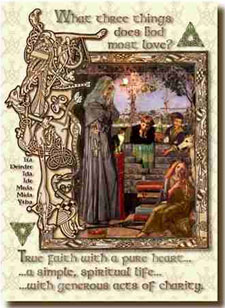
The community also became known as a training school for little boys, many of whom later became famous churchmen. One of these was St. Brendan the Navigator, whom Ita accepted in fosterage when he was a year old and kept until he was six. Brendan revisited her between his voyages and always deferred to her counsel. One day, Brendan asks her what are the three things which most please and displease God. Ita tells him: a pure heart with faith in God, a simple spiritual life, and generous acts of charity are most pleasing to God, and the three things most offensive to God are a mouth full of hate, a heart full of resentment, and worship of material things.
Second only to Saint Brigid among the most beloved of the Irish women saints, St. Ita is sometimes called the 'Brigid of Munster', but actually the differences were more striking than the resemblances between these two towering saints of the Celtic church. Brigid's effective life as a nun was spent in continual movement. When she successfully established of one settlement, she moved off to found another. Ita did just the opposite, She established a single foundation in a district where there was none, and there she remained all her life. There is an emphasis on austerity in Ita's life not found in Brigid's. Ita's dedication to the ascetic lifestyle was unswerving throughout her life, and at times, almost dangerous. An angel came to warn her about her excessive fasting, which sometimes continued into four days.
As with many of the great saints, Ita foresees and predicts her own death. As she felt her end approaching she sent for her community of nuns, and invoked the blessing of heaven on the clergy and laity of the district around Killeedy. Then messengers came from Clonmacnoise, wanting her to bless water for their abbot, Aengus, who was very ill. She duly obliges, but after the messengers have left, she tells her sisters that both she and Aengus will die before the emissaries return to Clonmacnoise. Ita proves to be correct on both counts.
Ita died on January 15, 570.
Monday, October 4, 2010
Francis of Assisi (316-397)
Francis and the Celtic Connection
 When Fancis of Assisi came on the scene in 1200 he embraced a style of Christianity with an emphasis on creation, care of the poor, the place of women in monastic communities that seemingly came out of nowhere.
In 613 Columbanus a Celtic missionary monk responsible for planting over 50 monastic communites throughout Europe arrives in Milan. The King of Lombardy offers Columbanus a site seventy miles south to establish a community. The location is where the Bobbio stream flows into the Trebbia. Columbanus gladly accepts. In 614 before the winter sets in, a new Irish monastery called Bobbio takes shape in the foothills of the Apennines. It is to be the last of Columbanus' foundations and his final resting place.
When Columbanus died, every branch of knowledge known in his day was represented in the library he established at Bibbio. The school of Bobbio became the intellectual center of northern Italy. His memory was so stamped upon the history of the region that the Roman Church sainted him despite it's opposition while he was alive.
Bibbio is 167 km from Assisi.
The similarities between Francis's vision of monastic life and the values of the Celtic monastics has not been lost on some historians. It is very possible Francis was wittingly or unwittingly influenced by the substantial mark left by Columbanus and his foundation some 600 years earlier in the area.
photo: the tomb of Columbanus in the Basilica of San Columbano in Bibbio
a living wate classic repost
In 613 Columbanus a Celtic missionary monk responsible for planting over 50 monastic communites throughout Europe arrives in Milan. The King of Lombardy offers Columbanus a site seventy miles south to establish a community. The location is where the Bobbio stream flows into the Trebbia. Columbanus gladly accepts. In 614 before the winter sets in, a new Irish monastery called Bobbio takes shape in the foothills of the Apennines. It is to be the last of Columbanus' foundations and his final resting place.
When Columbanus died, every branch of knowledge known in his day was represented in the library he established at Bibbio. The school of Bobbio became the intellectual center of northern Italy. His memory was so stamped upon the history of the region that the Roman Church sainted him despite it's opposition while he was alive.
Bibbio is 167 km from Assisi.
The similarities between Francis's vision of monastic life and the values of the Celtic monastics has not been lost on some historians. It is very possible Francis was wittingly or unwittingly influenced by the substantial mark left by Columbanus and his foundation some 600 years earlier in the area.
photo: the tomb of Columbanus in the Basilica of San Columbano in Bibbio
a living wate classic repost
Friday, July 16, 2010
Litany of the Celtic Saints (2)

John, beloved disciples of the Lord:
pray with us.
Fathers and mothers of the Desert,
people of prayer and bringer of wisdom:
pray with us.
people of prayer and bringer of wisdom:
pray with us.
Martin, saint of Tours,
builder of communities of hermits,
living simply, loving God;
Martin, soldier of Christ:
pray with us.
builder of communities of hermits,
living simply, loving God;
Martin, soldier of Christ:
pray with us.
Ninian of Whithorn,
apostle and example:
pray with us.
apostle and example:
pray with us.
Patrick of Britain,
missionary to the land of Ireland:
pray with us.
missionary to the land of Ireland:
pray with us.
Brigid, compulsive giver,
lover of the poor, Brigid of Kildare:
pray with us.
lover of the poor, Brigid of Kildare:
pray with us.
Columba of Iona, exiled from Ireland,
abbot and scribe, lover of Christ;
Columba now the gentle;
Columba of the Church:
pray with us.
abbot and scribe, lover of Christ;
Columba now the gentle;
Columba of the Church:
pray with us.
Oswald, king and saint,
willing interpreter of the Gospel truth;
Oswald, man of prayer:
pray with us.
willing interpreter of the Gospel truth;
Oswald, man of prayer:
pray with us.
Aidan, emissary from Iona;
gentle and straightforward;
torchbearer; liberator of slaves;
Aidan of Lindisfarne:
pray with us.
gentle and straightforward;
torchbearer; liberator of slaves;
Aidan of Lindisfarne:
pray with us.
Hild of Whitby,
firm leader of both men and women;
renowned for your counsel and insight,
releasing others in their giftedness;
Hild, woman of courage and faith:
pray with us.
firm leader of both men and women;
renowned for your counsel and insight,
releasing others in their giftedness;
Hild, woman of courage and faith:
pray with us.
Cuthbert of Northumbria,
hermit and joyous worshipper;
man of prayer and spiritual warfare;
patient minister of reconciliation;
Cuthbert of the people:
pray with us.
the graphic: found among the many stone carvings and ornaments in the ruins of Jerpoint Abbey, County Kilkenny.
Sunday, May 16, 2010
St Brendan (484 – 577)
The Prayer of St Brendan

Shall I abandon, O King of mysteries, the soft comforts of home?
Shall I turn my back on my native land, and turn my face towards the sea?
Shall I put myself wholly at your mercy, without silver, without a horse, without fame, without honour?
Shall I throw myself wholly upon You, without sword and shield, without food and drink, without a bed to lie on?
Shall I say farewell to my beautiful land, placing myself under Your yoke?
Shall I pour out my heart to You, confessing my manifold sins and begging forgiveness, tears streaming down my cheeks?
Shall I leave the prints of my knees on the sandy beach, a record of my final prayer in my native land?
Shall I then suffer every kind of wound that the sea can inflict?
Shall I take my tiny boat across the wide sparkling ocean? O King of the Glorious Heaven,
Shall I go of my own choice upon the sea?
O Christ, will You help me on the wild waves?
Saturday, May 16, 2009
St Brendan (484-577) in North America

From a montain monastary Brendan gazed out across the western ocean looking for a glimpse of distant lands. Some say he saw them revealed in a vision after fasting for 40 days. He and his band of brothers set out on a seven year journey in a Carrach or Coracle. A boat made from wood and leather coated in animal fat. They drifted free at the mercy of the wind, the whim of the waves and the will of God.
In the 1970’s a National Geographic expedition proved that not only was the voyage possible but that the explorers encountered many of the things Brendan did. Adding credence to a story dismissed by modernity as myth.
It is believed Brendan's voyage took him to the northern Isles of Scotland, the Faeroe islands, Greenland, Iceland and eventually Newfoundland. Many locations in these countries are named after Brendan.
Friday, May 16, 2008
St Brendan (486-575)

Born in Ireland in 486 known as Saint Brendan the Navigator, he is remembered with extreme fondness for his great sea voyages, which captured the hearts and minds of the people his day and many in the ages since. The stories of his voyages read as part travelouge and part spiritual allegory. He was educated by Ita and ordained by Bishop Erc.
There is a wonderful legend of how he and his traveling companions landed on an small isle that turned out to be a great fish that waited paitently for them to complete their celibration of the Holy Euchurist. It is believed he may have made it as far as North America. He was also responsible for establishing several major monastic communites. Particularly Clonfert in Galaway where he was eventually buried.
Subscribe to:
Posts (Atom)
