Showing posts with label mystics. Show all posts

Sunday, January 25, 2015

Henry Suso (c. 1300 - 1366)

Bl. Henry Suso (c. 1300 - 1366) studied theology under Meister Eckhart in Cologne. But Eckhart was more than a teacher to him: there is a touching account in Suso's autobiography of how he went to Eckhart when his hypersensitive conscience was tormenting him, and how Eckhart gave him complete peace. He entered the Dominican Order in his native Constance. Some years later he had a profound religious experience which he described in great detail. It was the beginning of a great love story, told with impressive literary skill in the tender language of courtly love. 'Eternal Wisdom [a feminine noun in German, as in most languages with noun-gender] offers herself in the Holy Scriptures very affectionately, as a fair beloved who adorns herself beautifully in order to be well pleasing to all men, speaking gently in the guise of a woman, in order to incline all hearts to herself.'
    The language of chivalry, parodied in a later century in Don Quixote, was still viable in Suso's century. 'Your young unruly heart,' he said to himself, 'can scarcely endure to be without a special object of love.' So he often 'meditated about her, thinking of her lovingly, and liking her full well with all his heart and soul.' The mediaeval knight delighted to suffer for the lady he worshipped.
    Two of his books are written as dialogue, a favourite literary form in the 14th century. The dialogue is between himself ('the disciple') and God ('Eternal Truth', which, like 'Eternal Wisdom', is a feminine noun). The theme is the death of the ego.

     Disciple:  Lord, what is true detachment?
   Truth: Take note with careful discrimination of these two words: oneself and leave. If you know how to weigh these two words properly, testing their meaning thoroughly to their core and viewing them with true discernment, then you can quickly grasp the truth.
    Take, first of all, the first word -- oneself or myself -- and see what it is. It is important to realise that everyone has five kinds of self. The first self we have in common with a stone, and this is being. The second we share with plants, and this is growing. The third self we share with animals, and this is sensation. The fourth we share with all other human beings: we possess a common human nature in which all are one. The fifth - which belongs to a person exclusively as his or her own - is one's individual human self…
    Now what is it that leads people astray and robs them of happiness? It is exclusively this last self. Because of it a person turns outward, away from God and toward this self, when he or she should be returning inward. Thus they fashion their own selves according to what is accidental. In their blindness they appropriate to themselves what is God's. This is the direction they take, and they eventually sink into sinfulness….
    Disciple: The truth be praised! Dear Lord, tell me, does anything (of this self) still remain in the happy, detached person?
    Truth: Without a doubt it happens that, when the good and loyal servant is led into the joy of his Lord, he becomes drunk from the limitless overabundance of God's house. What happens to a drunken man happens to him, though it cannot really be described, that he so forgets his self that he is not at all his self and consequently has got rid of his self completely and lost himself entirely in God, becoming one spirit in all ways with him, just as a small drop of water does which has been dropped into a large amount of wine. Just as the drop of water loses itself, drawing the taste and colour of the wine to and into itself, so it happens that those who are in full possession of blessedness lose all human desires in an inexpressible manner, and they ebb away from themselves and are immersed completely in the divine will. Otherwise, if something of the individual were to remain of which he or she were not completely emptied, scripture could not be true in stating that God shall become all things in all things. Certainly one's being remains, but in a different form, in a different resplendence, and in a different power. This is all the result of total detachment from self. 

Monday, September 29, 2014

Richard Rolle 1290, 1349


Richard Rolle Quotes


It behoves thee to love God wisely; and that may thou not do but if thou be wise.


Who breathe where you will, come into me and snatch me up to yourself.


The commandment of God is, that we love Our Lord in all our heart, in all our soul, in all our thought.


For love is a willful stirring of our thoughts unto God, so that it receive nothing that is against the love of Jesus Christ, and therewith that it be lasting in sweetness of devotion; and that is the perfection of this life.


The first is called insuperable, the second inseparable, the third singular.


Thy love is singular when all thy delight is in Jesus Christ and in no other thing finds joy and comfort.

Wednesday, November 27, 2013

Thought's from Bohme


"For he that will say, I have a Will, and would willingly do Good, but the earthly Flesh which I carry about me, keepeth me back, so that I cannot; yet I shall be saved by Grace, for the Merits of Christ. I comfort myself with his Merit and Sufferings; who will receive me of mere Grace, without any Merits of my own, and forgive me my Sins. Such a one, I say, is like a Man that knoweth what Food is good for his Health, yet will not eat of it, but eateth Poison instead thereof, from whence Sickness and Death, will certainly follow."

 Böhme, unlike Luther, does not believe that Mary was the Ever Virgin. Her virginity after the birth of Jesus is unrealistic to Böhme. The true salvation is Christ, not Mary. The importance of Mary, a human like every one of us, is that she gave birth to Jesus Christ as a human being. If Mary had not been human, according to Böhme, Christ would be a stranger and not our brother. Christ must grow in us as he did in Mary. She became blessed by accepting Christ. In a reborn Christian, as in Mary, all that is temporal disappears and only the heavenly part remains for all eternity. Böhme's peculiar theological language, involving fire, light and spirit which permeates his theology and Marian views, does not distract much from the fact that his basic positions are Lutheran, with the one exception of the virginity of Mary, where he holds a more temporal view.

 Böhme saw the incarnation of Christ not as a sacrificial offering to cancel out human sins, but as an offering of love for humanity, showing God's willingness to bear the suffering that had been a necessary aspect of creation. He also believed the incarnation of Christ conveyed the message that a new state of harmony is possible. This was somewhat at odds with Lutheran teachings, and his suggestion that God would have been somehow incomplete without the Creation was even more controversial, as was his emphasis on faith and self-awareness rather than strict adherence to dogma or scripture.


Monday, October 14, 2013

Thanks Giving (6)


Now Thank We Our God

1 Now thank we all our God
with heart and hands and voices,
who wondrous things has done,
in whom his world rejoices;
who from our mothers' arms
has blessed us on our way
with countless gifts of love,
and still is ours today.

2 O may this bounteous God
through all our life be near us,
with ever joyful hearts
and blessed peace to cheer us,
to keep us in his grace,
and guide us when perplexed,
and free us from all ills
of this world in the next.

3 All praise and thanks to God
the Father now be given,
the Son and Spirit blest,
who reign in highest heaven
the one eternal God,
whom heaven and earth adore;
for thus it was, is now,
and shall be evermore


                            Martin Rinckart 1586 - 1649

Thursday, October 3, 2013

Therese of Lisieux (1873- 1897)


Therese Martin was the youngest of 9 children. Her mother died when she was four. At age 15 she became a carmelite nun, though she had desired to do this earlier.

Her intention was to offer herself as a missionary nun to a work in Vietnam. The on set of tuberculosis made this impossible. She died only nine years into her life in the convent.

She kept extensive journals that were reworked after her death and published by her sister.

Therese loved nature. She often used the imagery of nature to explain how the Divine Presence is everywhere. She was convinced everything is connected in God's loving care.

Therese saw herself as 'the Little Flower of Jesus.' Just as the simple wild flowers in forests and fields. They go unnoticed by the greater population, yet grow under the caring eye of God. This was how Therese understood herself before the Lord - simple and hidden. Blooming where God had planted her."

for further info go to
http://en.wikipedia.org/wiki/Thérèse_de_Lisieux


living water reprint from 2008

Saturday, May 4, 2013

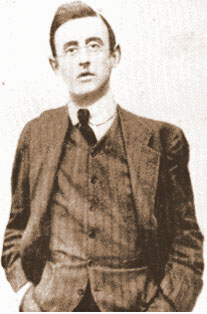
Joseph Mary Plunkett (1887 - 1916)

The Splender of God

The drunken stars stagger across the sky,
The moon wavers and sways like a wind-blown bud,
Beneath my feet the earth like drifting scud
Lapses and slides, wallows and shoots on high;
Immovable things start suddenly flying by,
The city shakes and quavers, a city of mud
And ooze—a brawling cataract is my blood
Of molten metal and fire—like God am I.

When God crushes his passion-fruit for our thirst
And the universe totters—I have burst the grape
Of the world, and let its powerful blood escape
Untasted—crying whether my vision durst
See God’s high glory in a girl’s soft shape—
                                                     God! Is my worship blessed or accurst?

 Joseph Mary Plunkett .was born in Dublin and educated at Catholic University School, Belvedere College and Stonyhurst College. For a while he was editor of the Irish Review. He was a close friend of Thomas MacDonagh and Padraic Pearse, noted Irish poets. Along with MacDonagh and Edward Martyn, he co-founded the Irish Theatre.

During the 1916 Rising he was one of the signers of the Proclamation of the Irish Republic. He was imprisoned by the English army in the Richmond Barracks. Shortly before his execution in the courtyard of Kilmainham jail, on the morning of May 4th, he married his fiance, Grace Gifford, in the jail's chapel. He died at the age of 28. One of the best known romantic tragedies, his marriage to Grace has become both song and fable.

His friend, Thomas MacDonagh was executed the day before. The interrelationships between the poets of Dublin emerge many times. Francis Ledwidge, another of the poets of the day, wrote a Lament to thomas MacDonagh. Joseph's father and brother John, who were also involved in the 1916 uprising, served ten years penal servitude. Joseph's wife, Grace, was also later imprisoned in the Kilmainham jail.
 
 Plunkett was deeply influenced  by his study of the mystics, including Saint John of the Cross, Saint Theresa of Avila and Saint Francis de Sales. His  poetry was published in two volumes: "The Circle and the Sword", in 1911 and the “Occulta", published posthumously. His sister, Geraldine Plunkett acted as editor and contributed a foreword.


Sunday, February 24, 2013

Walter Hilton (1340 - 1394)

Little is known of  Walter Hilton's personal life, apart from his writings. We do know that he abandoned a promising career as a  lawyer. he may have completed the studies and examinations that would have entitled him to become a Master of canon law, but without undertaking the regency that would have given him the latter title. Prior to 1386, he retired from the world as a hermit,when he developed a deep devotion to the Carthusian Order.


His spiritual writings were influential during the fifteenth century in England. The most famous of these are the two volumes of Scale of Perfection. It survives in some sixty-two manuscripts, including fourteen of a Latin translation by Hilton's contemporary in Cambridge  the Carmelite friar Thomas Fishlake.  In Fishlake's translation, the Scale became the first work written in English to circulate on the European continent. It was printed by  Wynken Worde in Westminster in 1494, at the request of Lady Margret Beauford  the mother of King Henry VII, and five more times before the English Reformation of the 1530s.

The first book of Scale is addressed to a woman recently enclosed as an anchoress, providing her with appropriate spiritual exercises; the bulk of its ninety-three chapters deal with the extirpation of the 'foul image of sin' in the soul—the perversion of the image of the Trinity in the three spiritual powers of Mind, Reason and Will (reflecting the Father, Son and Holy Spirit respectively, according to a tradition drawn from St Augustine) -- through a series of meditations on the seven deadly sins. The second book, which opens by addressing itself to Hilton's former reader, who, he says, has further questions, seems from its style and content rather to be addressed to a larger, perhaps more sophisticated audience; its major themes are the reformation of the soul in faith alone and in both faith and feeling. This latter is described in an extended metaphor as a spiritual journey to Jerusalem, or 'peace' in meditation, a gift which is also its own giver, Christ. The first book of the Scale was apparently written some time before the second, and circulated independently.

In 1386, he wrote the Latin epistle of spiritual counsel, De Utilitate et Prerogativis Religionis, for his friend Adam Horsley, a former officer of the Exchequer, who was about to enter the Carthusian Order. According to manuscript tradition, Hilton died as an Augustinian regular  in the priory of St Peter  in Nottinghamshire. However, this manuscript was written much later than the history it reports, and it contains a number of historic mistakes

Sunday, January 13, 2013

George Fox (1624 - 1691 )

 Walt whitman who was raised by parents inspired by Quaker thought, later wrote: "George Fox stands for something —a thought—the thought that wakes in silent hours—perhaps the deepest, most eternal thought latent in the human soul. This is the thought of God, merged in the thoughts of moral right and the immortality of identity. Great, great is this thought—aye, greater than all else."
                                                                                                                                                     
The son of a Leichestershire weaver, Fox lived in a time of great social upheaval and war. He rebelled against the religious and political authorities of the day by proposing an unusual and uncompromising approach to the Christian faith,. While working as a shoemakers apprentice, He felt called to travel in search of enlightenment 

After years of internal struggle he found peace when he surrendered to what  he described as the "inner light of the living Christ".  Preaching from this inner light He traveled throughout Britain as a dissenting preacher, for which he was often persecuted by the authorities who disapproved of his beliefs.

In prayer and meditation he came to a greater understanding of the nature of his faith and what it required from him; this process he called "opening". He also came to what he deemed a deep inner understanding of standard Christian beliefs.This lead to his  establishing the society of friends (the Quakers )

Among his ideas were:
  • Rituals can be safely ignored, as long as one experiences a true spiritual conversion.
  • The qualification for ministry is given by the Holy Spirit not by ecclesiastical study. This implies that anyone has the right to minister, assuming the Spirit guides them, including women and children.
  • God "dwelleth in the hearts of his obedient people": religious experience is not confined to a church building.  Fox refused to apply the word "church" to a building. Fox would just as soon worship in fields and orchards, believing that God's presence could be felt anywhere.
  • Though Fox used the Bible to support his views, Fox reasoned that, because God was within the faithful, believers could follow their own inner guide rather than rely on a strict reading of Scripture or the word of clerics.
  • Fox made no clear distinction between Father, Son and Holy Spirit.
 Fox married Margret Fell, the widow of one of his wealthier supporters; she was among one of many woman leaders among the Friends. His ministry expanded and he undertook tours of  North America, the West Indies and the Low countries. In the middle of those trips  he was imprisoned for over a year. He spent the final decade of his life working in London to organize the expanding Quaker movement.

Fox's charisma, selflessness, tireless commitment, deep spirituality and organizational abilities made him a remarkably charismatic personality. His greates legacy to the society of friends became the movements profound dedication to the work of peace, reconciliation and non-violence.

 compiled from several sources

Monday, December 10, 2012

Mystical Verse (4)

Now Thank We Our God

1 Now thank we all our God
with heart and hands and voices,
who wondrous things has done,
in whom his world rejoices;
who from our mothers' arms
has blessed us on our way
with countless gifts of love,
and still is ours today.

2 O may this bounteous God
through all our life be near us,
with ever joyful hearts
and blessed peace to cheer us,
to keep us in his grace,
and guide us when perplexed,
and free us from all ills
of this world in the next.

3 All praise and thanks to God
the Father now be given,
the Son and Spirit blest,
who reign in highest heaven
the one eternal God,
whom heaven and earth adore;
for thus it was, is now,
and shall be evermore


                            Martin Rinckart 1586 - 1649

Tuesday, November 27, 2012

Gregory of Siani ( died 1346 )


Born in Smyrna, he was captured by Turks as a young man. He was eventually ransomed to Cyprus and became a monk at Saint Cathrine monastery on Mount Sinai. Later  he moved to Crete where he learned the practice of the Jesus prayer and hesychasm from the monk Arsenios. 

Eventuallyi n 1310 he moved to Hount Athos  to the Magoula skete near Phileotho Monestary  where he remained until 1335. Thus, having gained the experience of many centuries of the monastic life from the ancient monasteries, Gregory settled down in a solitary place for the purpose of pursuing "hesychia" (stillness doing the Jesus Prayer). 

With his contemporary Gregory of Palamas, he helped to establish Mount Athos as a center of hesychasm. From there he wrote and traveled widely teaching this approach to contemplation as a method of union with God.

Concerned with spreading of monasticism, Gregory founded several cells on Mount Athos, as well as four monasteries in Thrace.

Increasing Muslim raids on Athos pushed Gregory and some disciples into the Bulgarian empire, where he would find protection under Bulgarian Emperor Ivan Alexander and where he founded a monastery near Paroria, Strnadzah mountains in south east Bulgaria where he died on November 27th 1346.

 The Philokalia includes five works in Greek by Gregory,
  • On Commandments and Doctrines, Warnings and Promises; on Thoughts, Passions and Virtues, and also on Stillness and Prayer: 137 Texts
  • Further Texts
  • On the Signs of Grace and Delusion, Written for the Confessor Longinos: Ten Texts
  • On Stillness: Fifteen Texts
  • On Prayer: Seven Texts

Wednesday, November 21, 2012

Jakop Boehme ( 1575 - 1624 )

This German protestant mystic and theologian, was born in the East German town of Goerlitz in 1575. He had little in the way of a formal education and made his living as a shoemaker; he married and had four children.  He is considered an original thinker within the Lutheran tradition, his thought drew from  a wide range of  interests including Paracelsus, the Kabbala, alchemy and the Hermetic tradition. 

 Böhme had a number of mystical experiences throughout his youth, culminating in a vision in 1600 as one day he focused his attention onto the exquisite beauty of a beam of sunlight reflected in a pewter dish. He believed this vision revealed to him the spiritual structure of the world, as well as the relationship between God and man, and good and evil. At the time he chose not to speak of this experience openly, preferring instead to continue his work and raise a family

 In 1610 Böhme experienced another inner vision in which he further understood the unity of the cosmos and felt that he had received a special vocation from God.

 Twelve years after the vision in 1600, Böhme began to write his first book, Die Morgenroete im Aufgang (The rising of Dawn). The book was given the name Aurora by a friend; however, Böhme originally wrote the book for himself and it was never completed. A manuscript copy of the unfinished work was loaned to Karl von Ender, a nobleman, who had copies made and began to circulate them. . Like Eckhart and others, Boehme's thought drew fire from the church authorities, who silenced him for five years. In 1618 Boehme began writing again, this time in secrecy  after the persistent  insistence of friends who had read Aurora,

In 1619 Böhme wrote "De Tribus Principiis" or "On the Three Principles of Divine Being". It took him two years to finish his second book, which was followed by many other treatises, all of which were copied by hand and circulated only among friends. In 1620 Böhme wrote "The Threefold Life of Man", "Forty Questions on the Soul", "The Incarnation of Jesus Christ", "The Six Theosophical Points", "The Six Mystical Points". 

In 1622 Böhme wrote "De Signatura Rerum". In 1623 Böhme wrote "On Election to Grace", "On Christ's Testaments", "Mysterium Magnum", "Clavis (Key)". The year 1622 saw Böhme write some short works all of which were subsequently included in his first published book on New Year's Day 1624, under the title Weg zu Christo The Way to Christ.

 He again raised the cockles of church authorities, and he was banished from his home. He died soon thereafter, in 1624, after returning home from Dresden. His last words spoken, as he was surrounded by his family, were reported to be, "Now I go hence into Paradise."

Poets such as John Milton, Ludwig Tiack, Novalis and William blake found inspiration in Böhme's writings.  His thought influenced  major figures in philosophy, especially German Romantics such as   Baader, Schelling and Hegel. Hegel.went as far as to say that Böhme was "the first German philosopher."   

Indirectly, his influence can be traced to the work of Schopenhauer, Nietzsche, Hartmann, Bergson, and Heidegger.  Paul Tillich and Martin Buber drew heavily from his work -- as did the psychologist, Carl Jung, who made numerous references to Boehme in his writings. Hegel, Baader, and Schelling. . Further,

compiled from several sources


 graphic:upper left cover pagefor one of Boehme's tracts
             bottom right, from The Life and Doctrines of Jacob Boehme. by Franz Hartmann

Wednesday, November 14, 2012

Gregory Palamas ((1296–1359)

Gregory was born in Constantinople. His father was a courtier of the Byzantine emperor Andronikas II, but he died soon after Gregory was born. The Emperor himself groomed the the fatherless boy he would devote himself to government service.

 Despite the Emperor's ambitions for him, Gregory, then barely twenty years old, withdrew to Mount Athos  becaming a novice. Eventually, he was tonsured a monk, and continued his life of asceticism

Gregory spent eight years of spiritual struggle and eventually transferred to the Great Larva on Mount Athos, where he served the brethren in the refectory and  as a cantor. Wishing to devote himself more fully to prayer and asceticism he entered a skete called Glossia, where he taught the ancient practice of contemplative prayer known as "prayer of the heart" or Hesychasm.

 Barlaam an Italian born convert to Eastern Orthodoxy was scandalized by hesychasm after he encountered contemplatives during a visit to Mount Athos. Trained in the mode of Western Scholastic Theology, Barlaam propounded a more intellectual and propositional approach to the knowledge of God than that of the Contemplatives. He began to combat hesychasm both orally and in his writings

On the Hesychast side,  Palamas was asked by his fellow monks on Mt Athos to defend hesychasm from the attacks of Barlaam. Palamas was well-educated in Greek philosophy. In response to Barlaam's attacks, Palamas wrote nine treatises entitled "Triads For The Defense of Those Who Practice Sacred Quietude". The treatises are called "Triads" because they were organized as three sets of three treatises. He also  defended hesychasm at six different synods in Constantinople where finally in 1351Barlaam's opposition to Hesychasm was finally ended.

Palamas's opponents in the Hesychast controversy spread slanderous accusations against him, and in 1344  imprisoned him for four years.Gregory was released from prison and became the Bishop of  Thessaloniki
However, since the conflict with Barlaam had not been settled at that point, the people of Thessalonika did not accept him, and he was forced to live in a number of places. It was not until 1350 that he was able to serve as Bishop In 1354, during a voyage to Constantinople, the ship he was in fell into the hands of Turkish pirates; he was imprisoned and beaten. He was obliged to spend a year in detention at the Ottoman court where he was well treated. Eventually his ransom was paid and he returned to Thessaloniki, where he served as Archbishop for the last three years of his life.

Palamas died on November 14, 1359. His dying words were, "To the heights! To the heights!" He was canonized a saint of the Eastern Orthodox Church in 1368 

compiled from several sources

graphics: upper left ancient Icon of Gregory. bottom right; the triads, the classics of western spirituality series


Monday, October 15, 2012

Teresa of Avila (1515-1582)


"Christ has no body now, but yours.
No hands, no feet on earth, but yours.
Yours are the eyes through which
Christ looks compassion into the world.
Yours are the feet
with which Christ walks to do good.
Yours are the hands
with which Christ blesses the world." 

                        from the writing of Teresa of Avila

Sunday, September 30, 2012

thoughts and prayers of Richard Rolle

O Holy Spirit, Who breathe where you will, come into me and snatch me up to yourself. Fortify the nature you have created, with gifts so flowing with honey that, from intense joy in your sweetness, it may despise and reject all which is in this world, that it may accept spiritual gifts, and through melodious jubilation, it may entirely melt in holy love, reaching out for circumscribed Light.”

Lord Jesu, I ask Thee, give unto me movement in Thy love without measure; desire without limit; longing without order; burning without discretion. Truly the better the love of Thee is, the greedier it is; for neither by reason is it restrained, nor be dread thronged, nor by doom tempted.” 

The commandment of God is, that we love Our Lord in all our heart, in all our soul, in all our thought. In all our heart; that is, in all our understanding without erring. In all our soul; that is, in all our will without gainsaying. In all our thought; that is, that we think on Him without forgetting. In this manner is very love and true, that is work of man's will. For love is a willful stirring of our thoughts unto God, so that it receive nothing that is against the love of Jesus Christ, and therewith that it be lasting in sweetness of devotion; and that is the perfection of this life.”

  It behooves thee to love God wisely; and that may thou not do but if thou be wise. Thou art wise when thou art poor, without desire of this world, and despisest thyself for the love of Jesus Christ; and expendeth all thy wit and all thy might in His service. Whoso will love wisely, it behooves him to love lasting things lastingly, and passing things passingly; so that his heart be set and fastened on nothing but in God.” 

graphic: Portrait from Cotton MS Faustina

Saturday, September 29, 2012

Richard Rolle (1300 - 1349 )

One of the most appreciated English mystic authors of the middle ages. Rolle's lightheartedness blends with profound understanding of the role of sexual longing and sensual imagery in the search for union with God. Living as a hermit for thirty  one years with the help of patrons. The level of financial support that Rolle enjoyed was a new development in the treatment of religious recluses.

Born into a small farming family near Pickering, he studied at the University of oxford, where he was accompanied by a  patron Thomas de Neville, the Archdeacon of Durham  He showed little interest in  scholastic pursuits, instead displaying a devotion to study of the scripture he learned Latin during his time there.Rolle left Oxford at age eighteen or nineteen. Fearing he had ceded too greatly to temptation in his youth, and that he would transgress further, he adopted the life of a hermit devoting himself to study of the word and contemplation.. He had his cell first at Pickering, Rolle, guided by his conscience, was often misunderstood.

Two years and eight months after becoming a hermit, Rolle had his first mystical experience. Around a year later, he felt similarly after listening to a choir.

 In one of his best-known works, The Fire of Love Rolle provides an account of these mystical experiences, which he describes as being of three kinds: a physical warmth in his body, a sense of wonderful sweetness, and a heavenly music that accompanied him as he chanted the Psalms.

Speaking of  his first mystical experience Rolle writes "I felt within me a merry and unknown heat...I was expert it was not from a creature but from my Maker, as it grew hotter and more glad." .

 The book was widely read and described the four purgative stages that one had to go through to become closer to God:  Described as open door, heat, song, and sweetness.

 On the contemplative life, he wrote, "There are many active men better than some contemplatives", though, "the best contemplatives are better than the best actives

 Near the end of his life he became the spiritual director for a Cisterian convent. He wrote The Form of Living and his English Psalter for a nun there, Margaret Kirkby and Ego Dormio for a nun at Tedingham. He died in 1349, the first year of the Black Death in  England, which may have been the cause of his death

Monday, September 17, 2012

Hildegard von Bingen (1098 - 1179 )

 
Verse of Hildegard Von Bingen
 
Love abounds in all things,
excels from the depths to beyond the stars,
is lovingly disposed to all things.
She has given the king on high
the kiss of peace.
 
                          Caritas abundat
 
 
The marvels of God are not brought forth from one's self.
Rather, it is more like a chord, a sound that is played.
The tone does not come out of the chord itself, but rather,
through the touch of the Musician.
I am, of course, the lyre and harp of God's kindness.
       
                                               Soul Weavings
 
The soul is kissed by God in its innermost regions.
With interior yearning, grace and blessing are bestowed.
It is a yearning to take on God's gentle yoke,
It is a yearning to give one's self to God's Way.
 
                                                            Soul Weavings
 
 
O Eternal God, now may it please you
to burn in love
so that we become the limbs
fashioned in the love you felt
when you begot your Son
at the first dawn
before all creation.
And consider this need which falls upon us,
take it from us for the sake of your Son,
and lead us to the joy of your salvation.
 
                            O eterne deus"
 
Angels living light most glorious!
Beneath the Godhead in burning desire
in the darkness and mystery of creation
you look on the eye of your God
never taking your fill:
What glorious pleasures take shape within you!
 
                                                  "O gloriosissimi"
   

Saturday, September 15, 2012

Reflections on the Dark Night of the Soul


Place no hope in the feeling of assurance, in spiritual comfort. You may well have to get along without this. Place no hope in the inspirational preachers of Christian sunshine, who are able to pick you up and set you back on your feet and make you feel good for three or four days–until you fold up and collapse into despair. Self-confidence is a precious natural gift, a sign of health. But it is not the same thing as faith. Faith is much deeper, and it must be deep enough to subsist when we are weak, when we are sick, when our self-confidence is gone, when our self-respect is gone.
                                                                                   Thomas Merton


 Faith takes us to deep places, to the ruptures in our self-confidence and our lives. Do not settle for spiritual comfort all the time…Darkness is divine also. Faith is not about positive thinking so much as about what kicks in when we are weak, sick, and short of self-confidence. The via positiva never stands alone. The via negativa is always with us on our faith journey as well.
                                                                                 Matthew Fox

My own heart let me more have pity on; let
Me live to my sad self hereafter kind,
Charitable; not live this tormented mind
With this tormented mind tormenting yet.
I cast for comfort I can no more get
By groping round my comfortless, than blind
Eyes in their dark can day or thirst can find
Thirst ‘s all-in-all in all a world of wet.

Soul, self; come, poor Jackself, I do advise
You, jaded, let be; call off thoughts awhile
Elsewhere; leave comfort root-room; let joy size
At God knows when to God knows what; whose smile
‘s not wrung, see you; unforeseen times rather – as skies
Betweenpie mountains – lights a lovely mile.

                                                                       Gerard Manley Hopkins


There is no coming to consciousness without pain. People will do anything, no matter how absurd, to avoid facing their own soul. One does not become enlightened by imagining figures of light, but by making the darkness conscious.
                                                                         Carl Gustav Jung

 Facing the darkness, admitting the pain, allowing the pain to be pain, is never easy. This is why courage – big-heartedness – is the most essential virtue on the spiritual journey.  But if we fail to let pain be pain – and our entire patriarchal culture refuses to let this happen – then pain will haunt us in nightmarish ways. We will become pain’s victims instead of the healers we might become.
                                                                              Matthew Fox

Friday, August 24, 2012

Simone Weil (1907-1943)

Someone Wiel's Reflections on the  Recitation of the Lords Prayer

 The Our Father from Matthew 6,9-13 was the only prayer Simone Weil recited, at first only for its beauty, but afterwards she writes that she found herself repeatedly in the presence of Christ after praying it. She describes this experience in her letter to Father Perrin written as she left for America from Casablanca in May of 1942.


Up until last september, I had not prayed even once in my life, at least in the litteral sense of the word. I had never addressed words to God aloud or mentally

 The virtue of this practice is extraordinary and surprises me every time I do it, for, even though I live it every day, it goes beyond my expectation every time. Sometimes the first words already tear my thought outside my body and transport it to a place outside space from which there is neither perspective or point of view. Space opens up. The infinity of ordinary space is replaced by an infinity to second or third power. At the same time this infinity of infinities fills itself to the brim with silence, a silence that is not an absence of sound, and that is the object of a positive sensation, more positive than that of a sound. Noises, if there are any, only reach me after going through this silence.
 
Sometimes also, during this recitation or at other moments, Christ is present in person, but with a presence that is infinitely more real, more poignant, more clear and more full of love than the first time he took me.

I never would have taken it upon me to tell you all this if I wasn't leaving. And as I leave with more or less the thought of a probable death, it seems to me that I do not have the right to not speak of these things. For after all, in all of this, it's not about me. It's about God. I have nothing to do with it.

 The words of the Pater are perfectly pure. If you recite the Pater with no other intention than to pay the fullness of one's attention on the words themselves, you are completely sure to be delivered by this means from a part, as small as it may be, of the evil you hold inside you

 The only pure things down here are sacred objects and texts, the beauty of nature if you look at it for itself and not as a place for your reveries, and, to a lesser extent, human beings in whom God lives and works of art issued from divine inspiration.

 That which is perfectly pure can not be anything else but God present down here. If it was something else than God, it would not be pure. If God was not present, we would never be saved. In the soul where there has been a contact with purity, all its horror of the evil that it carries inside it changes into love for divine purity. This is how Mary-Magdalene and the good thief were privileged by love.

Wednesday, July 25, 2012

The Christian Book of Mystical Verse


Tozer compiled many of Christianity's  profound mystical voices. In His own word..
"The purpose of this book is to bring together in one convenient volume 
some of the best devotional verse the English language affords, and thus
 to make available to present day Christians a rich spiritual heritage 
which the greater number of them for various reasons do not now enjoy. 

For Tozer, these mystics had “been brought by the gospel into intimate fellowship with the Godhead.”  Tozer didn't  not want these voices to be ignored or forgotten gathered them together “to make available to present-day Christians a rich spiritual heritage which the great number of [us] for various reasons do not now enjoy.”

"This is a book is intended the  worshiper rather than for the student.  
It has been carefully and lovingly prepared for those God-enamored 
persons who, while they feel as deeply as the enraptured poet, yet 
lack the gift that would enable them to express their feelings adequately." 

The hymns and poems Tozer has compiled are mystical in the sense that they are God-oriented—they begin with God, embrace the worshiping soul and return to God again.
"The word mystic as it occurs in the title of this book refers to that
 personal spiritual experience common to the saints of Bible times
 and well known to multitudes of persons in the post-Biblical era.


I personal came across this priceless little volume in 1980. while reading Tozer's "The pursuit of God."  It was through these pages i became acquainted with the  christian mystics.  I'm ever grateful to Tozer for the introduction to this deep, rich and often ignored and forgotten  stream  of  the christian tradition. My heart was emblazoned by their passion and i never turned back. The mystics have been constant companions, fellow pilgrims,  bell weather voices in my journey toward the Divine.I highly recommend Mystical verse to any post modern pilgrim who hungers for solid food on the journey toward the divine presence.

 It was here i found kindred spirits in the poetry, hymns and devotional writing  of   Isaac Watts, Frederick William Faber, Christina Rossetti, Charles Wesley, Paul Gerhardt, Madame Guyon, oliver wendall holmes and Gerhard Terstegan and to name only a few. You'll find many of these voices already represented here at   Living water from an ancient well.