Showing posts with label peace. Show all posts

Friday, April 25, 2014

William Cowper (1731-1800)


Jehovah-Shalom. The Lord Send Peace

(Judges, vi.25)
    Jesus! whose blood so freely stream'd
    To satisfy the law's demand;
    By Thee from guilt and wrath redeem'd,
    Before the Father's face I stand.
     
    To reconcile offending man,
    Make Justice drop her angry rod;
    What creature could have form'd the plan,
    Or who fulfil it but a God?
     
    No drop remains of all the curse,
    For wretches who deserved the whole;
    No arrows dipt in wrath to pierce
    The guilty, but returning soul.
     
    Peace by such means so dearly bought,
    What rebel could have hoped to see?
    Peace by his injured Sovereign wrought,
    His Sovereign fasten'd to a tree.
     
    Now, Lord, Thy feeble worm prepare!
    For strife with earth and hell begins;
    Conform and gird me for the war;
    They hate the soul that hates his sins.
     
    Let them in horrid league agree!
    They may assault, they may distress;
    But cannot quench Thy love to me,
    Nor rob me of the Lord my peace. 
     
        Willam Cowper 
     
     
     Graphic: Sarah faith

Friday, April 4, 2014

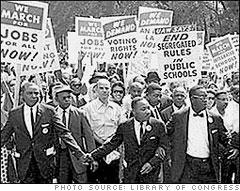
Martin Luther King Jr. on Peace & Justice (1929-1968)


Nonviolence is absolute commitment to the way of love. Love is not emotional bash; it is not empty sentimentalism. It is the active outpouring of one's whole being into the being of another.
--Martin Luther King, Jr., 1957 (1929-1968)


We must move past indecision to action. We must find new ways to speak for peace in Vietnam and for justice throughout the developing world, a world that borders on our doors. If we do not act, we shall surely be dragged down the long, dark, and shameful corridors of time reserved for those who possess power without compassion, might without morality, and strength without sight.
--Martin Luther King, Jr., "Conscience and the Vietnam War" in The Trumpet of Conscience (1968)

I refuse to accept the cynical notion that nation after nation must spiral down a militaristic stairway into the hell of nuclear annihilation... I believe that even amid today's mortar bursts and whining bullets, there is still hope for a brighter tomorrow... I still believe that one day mankind will bow before the altars of God and be crowned triumphant over war and bloodshed.
--Martin Luther King, Jr., Address in Acceptance of Nobel Peace Prize - 10 December 1964

In struggling for human dignity the oppressed people of the world must not allow themselves to become bitter or indulge in hate campaigns. To retaliate with hate and bitterness would do nothing but intensify the hate in the world. Along the way of life, someone must have sense enough and morality enough to cut off the chain of hate. This can be done only by projecting the ethics of love to the center of our lives.
----Martin Luther King, Jr., undated

World peace through nonviolent means is neither absurd nor unattainable. All other methods have failed. Thus we must begin anew. Nonviolence is a good starting point. Those of us who believe in this method can be voices of reason, sanity, and understanding amid the voices of violence, hatred, and emotion. We can very well set a mood of peace out of which a system of peace can be built.
----Martin Luther King, Jr., December 1964

Tuesday, December 10, 2013

Thomas Merton (1915-1968)


Prayer for Peace
 
Almighty and merciful God, Father of all men, Creator and ruler of the universe,
Lord of all history, whose designs are without blemish, whose compassion for
the errors of men is inexhaustible, in your will is our peace.

Mercifully hear this prayer which rises to you from the tumult and desperation
of a world in which you are forgotten, in which your name is not invoked,
your laws are derided and your presence is ignored. Because we do not
know you, we have no peace.

From the heart of an eternal silence, you have watched the rise of empires
and have seen the smoke of their downfall. You have witnessed the impious
fury of ten thousand fratricidal wars, in which great powers have torn whole
continents to shreds in the name of peace and justice.

A day of ominous decision has now dawned on this free nation. Save us then
from our obsessions! Open our eyes, dissipate our confusions, teach us
to understand ourselves and our adversary. Let us never forget that sins
against the law of love are punishable by loss of faith, and those
without faith stop at no crime to achieve their ends!

Help us to be masters of the weapons that threaten to master us.
Help us to use our science for peace and plenty, not for war and
destruction. Save us from the compulsion to follow our adversaries
in all that we most hate, confirming them in their hatred and
suspicion of us. Resolve our inner contradictions, which now
grow beyond belief and beyond bearing. They are at once a torment
and a blessing: for if you had not left us the light of conscience,
we would not have to endure them. Teach us to wait and trust.

Grant light, grant strength and patience to all who work for peace.
But grant us above all to see that our ways are not necessarily
your ways, that we cannot fully penetrate the mystery of your
designs and that the very storm of power now raging on this earth
reveals your hidden will and your inscrutable decision.

Grant us to see your face in the lightning of this cosmic storm,

O God of holiness, merciful to men. Grant us to seek peace where
it is truly found. In your will, O God, is our peace.

Amen. 


a living water reprint from 2010

Wednesday, September 25, 2013

Cadoc (? - 570)

St. Cadoc one of the great Welsh saints, Cadoc was born around 497 in Gelligaer he began life under a cloud of violence. His father, Gwynllyw the Bearded, was a robber chieftain and one of the lesser kings of Wales.

Cadoc's father stoled a cow belonging to the Irish monk, St. Tathyw. When the monk came fearlessly to reclaim the animal, Gwynllyw asked him to baptise his son and surrender him to the monks care. Cadoc was raised at Caerwent in Monmouthshire by Tathyw, who later became a hermit.

In adulthood, Cadoc refused to take charge of his father's army and instead founded a hermitage at Llancarfan that grew into a Monastery. The monastic community near Cardiff became a famous centre of learning in Wales.

He proselytized over a large area of his own country and went as a missionary to Brittany coast in France.

Cadoc went on pilgrimages to both Jerusalem and Rome and was distressed that the Synod of Llanddewi Brefi was held during one of these absences.

Returning to Britain he was martyred near Weedon, England by the occupying Saxons.

Cadoc's story appears in a
Vita Cadoci written shortly before 1086 by Lifris of Llancarfan. He came into conflict with king Arthur, who is mentioned twice in the vita, as great and bold but willful. The reference is important as one of seven sources mentioning Arthur independently of Geoffrey of Monmouth's Historia Regum Britanniae and adds credance to the historicity of Arthur.


living water reprint from 2008

Monday, November 12, 2012

Josaphat & Charles Simeon

Ironical today marks the feast days of two  men who suffered greatly while working toward understanding  and tolerance in the family of Christ.

Josaphat (1580-1623)

An orthodox monk who believed the schism between the eastern and western church should be bridged. After his ordination he became eloquent on the issue. Once elected archbishop he focused on clerical and lay reform. Fear of Rome lead a group of bishops to oppose him, stirring up controversy. As an act of conciliation he visited the churches that opposed him. It was while preaching at one of these that an angry mob grabbed him, smashed his skull and threw his body in o the river. he was canonized in1876 as a martyr for Christian unity

 Charles Simeon (1759-1836)

His professional adult life was spent  serving as a chaplain at Cambridge University. Through out he remained deeply rooted in both the Anglican church and in the evangelical experience he had as an undergraduate.

He suffered greatly even physically at the hands of both the high church and the evangelicals. Ironically he garnered the love of those who were seekers.


Sunday, November 11, 2012

Remembrance Day


An Ancient Celtic Peace Blessing

If there is righteousness in the heart,
there will be beauty in the character.
If there is beauty in the character,
there will be harmony in the home.
If there is harmony in the home,
there will be order in the nation.
If there is order in the nation,
there will be peace in the world.
So let it be.

 
—Scottish Blessing

Tuesday, May 15, 2012

Peter Maurin (1877 - 1949 )

Peter Maurin an idealistic Roman Catholic social activist worked with Dorthy Day  in the slums of New York City establishing the  Catholic Workers Movement.

 He was born into a poor farming family in  southern France, where he was one of 24 children.  Maurin served in the Sillon  movement of Marc Sanger until he became disillusioned.  He briefly tried his hand at homesteading in  Saskatchewan. That ended when his partner was killed in a hunting accident.  He than traveled through out the eastern States for a few years, eventually settling in New York City. For a ten year period Maurin left his catholic faith,  "because I was not living as a Catholic should." 

In the mid-1920s, Maurin was working as a French tutor in the New York suburbs. It was at this time Maurin experienced a religious conversion. Inspired by the life of Francis of Assisi he ceased charging for his lessons and asked only that students give as they thought appropriate. During this portion of his life, he began composing the poetry that would later be called his Easy Essays


Peter Maurin  Dorothy Day meet for the first time  in December of1932.On returning to New York from Washington, D.C., where she had covered the Hunger March  for Commonwealth and America magazines.   she walked into her apartment to find Maurin waiting her in the kitchen. He had read some of her articles and had been told by then editor of Commonwealth, George Shluter, to look her up and exchange ideas.
                                                                                                      
The first four months were spent mainly with  Maurin ,  sharing ideas, synopses of books and articles, and analyzing all facets of daily life through the lens of his intellectual system. He suggested since she had a journalistic back ground, she start a newspaper, to "bring the best of Catholic thought to the man in the street in the language of the man in the street". May 1 1933, the heart of the Great Depression saw the 1st edition of  the  Catholic Worker hit the streets.

Maurin's ideas served as the inspiration for the creation of "houses of hospitality" for the poor, the agrarian endeavors of the Catholic Worker farms, and the regular "roundtable discussions for the clarification of thought" that began taking place shortly after the publication of the first issue of CW

.Maurin believed the Catholic Worker should stress life in small agricultural communities. As he liked to say, “there is no unemployment on the land.” He lived  much of his life in Easton Pennsylvania where he worked on  Maryfarm the first Catholic Worker-owned farming commune.

During the 30's and early forties he spent much of his time taking  part in many the Catholic Worker sponsered protests, traveling and lecturing  extensively at parishes, colleges, and meetings across the country, often in coordination with the speaking tours of Dorothy Day. 

 In 1944, Maurin began to lose his memory. His condition deteriorated until he died at Maryfarm on May 15, 1949.

Sunday, May 13, 2012

Mothers Day

  Mothers Day was originally birthed in the bosom of the early Peace Movement

Mother's Day Proclamation of 1870
Mother's Peace Day

This yearly event was first proposed by Julia Ward Howe. In 1870 she penned the Mothers Day Proclamation as  an antiwar observance. You may be more familiar with her name in relation to the lyrics of the  American Civil  War song Battle Hymn of the Republic, which she penned.

                                       "Mine eyes have seen the glory of the coming of the Lord;
                                He is trampling out the vintage where the grapes of wrath are stored;
                                     He hath loosed the fateful lightning of His terrible swift sword;
                                                               His truth is marching on.
                                                  Glory! Glory! Hallelujah! Glory! Glory! Hallelujah!
                                                  Glory! Glory! Hallelujah! His truth is marching on.


  Born  in 1819  to a wealthy and respected New York City family, Howe became a  woman suffrage leader, a prominent advocate of abolition, peace, racial justice and women's rights. as well as a published poet. Along with her husband Samuel Gridly Howe she co-published  "The Commonwealth", an anti-slavery paper.  In 1870 she devised the Mother's Day Proclamation and in 1872 on the second Sunday in June the first Mother's Peace Day rally was observed. The idea was widely accepted and rally's continued on that day for several years.  Unfortunately she was never able to have the day recognized as an official holiday. Mother's Peace day was the beginning of the mothers day holiday in the U.S. that is now observed in May.

 The gift's of candy's and flowers of the modern commercialized celebration bear little resemblance to Julia Ward Howe's original vision for Mother's Peace Day. 

Below is her original Mother's Day Proclamation in it's entirety:  

 Arise then...women of this day!
Arise, all women who have hearts!
Whether your baptism be of water or of tears!
Say firmly:
"We will not have questions answered by irrelevant agencies,
Our husbands will not come to us, reeking with carnage,
For caresses and applause.
Our sons shall not be taken from us to unlearn
All that we have been able to teach them of charity, mercy and patience.
We, the women of one country,
Will be too tender of those of another country
To allow our sons to be trained to injure theirs."
From the bosum of a devastated Earth a voice goes up with
Our own. It says: "Disarm! Disarm!
The sword of murder is not the balance of justice."
Blood does not wipe our dishonor,
Nor violence indicate possession.
As men have often forsaken the plough and the anvil at the summons of war,
Let women now leave all that may be left of home
For a great and earnest day of counsel.
Let them meet first, as women, to bewail and commemorate the dead.
Let them solemnly take counsel with each other as to the means
Whereby the great human family can live in peace...
Each bearing after his own time the sacred impress, not of Caesar,
But of God -
In the name of womanhood and humanity, I earnestly ask
That a general congress of women without limit of nationality,
May be appointed and held at someplace deemed most convenient
And the earliest period consistent with its objects,
To promote the alliance of the different nationalities,
The amicable settlement of international questions,
The great and general interests of peace.


On this Mother's Day. we pray for , peace and a hope filled future where no mother will  have to mourn the death of a child lost to  war...


Wednesday, April 4, 2012

Martin Luther King (1928 - 1968 )

10 Rare King Quotes
"Everything that we see is a shadow cast by that which we do not see."
"Every man must decide whether he will walk in the light of creative altruism or in the darkness of destructive selfishness."
"Shallow understanding from people of good will is more frustrating than absolute misunderstanding from people of ill will."
"The means by which we live have outdistanced the ends for which we live. Our scientific power has outrun our spiritual power. We have guided missiles and misguided men."
"The hope of a secure and livable world lies with disciplined nonconformists who are dedicated to justice, peace and brotherhood."
"The ultimate measure of a man is not where he stands in moments of comfort and convenience, but where he stands at times of challenge and controversy."
"We must develop and maintain the capacity to forgive. He who is devoid of the power to forgive is devoid of the power to love. There is some good in the worst of us and some evil in the best of us. When we discover this, we are less prone to hate our enemies."
"Whatever your life's work is, do it well. A man should do his job so well that the living, the dead, and the unborn could do it no better."
"We must learn to live together as brothers or perish together as fools."
"We must use time creatively."

Friday, December 10, 2010

Thomas Merton (1915-1968)


 Thomas Merton  (1915-1968)

Prayer for Peace
 
Almighty and merciful God, Father of all men, Creator and ruler of the universe,
Lord of all history, whose designs are without blemish, whose compassion for
the errors of men is inexhaustible, in your will is our peace.

Mercifully hear this prayer which rises to you from the tumult and desperation
of a world in which you are forgotten, in which your name is not invoked,
your laws are derided and your presence is ignored. Because we do not
know you, we have no peace.

From the heart of an eternal silence, you have watched the rise of empires
and have seen the smoke of their downfall. You have witnessed the impious
fury of ten thousand fratricidal wars, in which great powers have torn whole
continents to shreds in the name of peace and justice.

A day of ominous decision has now dawned on this free nation. Save us then
from our obsessions! Open our eyes, dissipate our confusions, teach us
to understand ourselves and our adversary. Let us never forget that sins
against the law of love are punishable by loss of faith, and those
without faith stop at no crime to achieve their ends!

Help us to be masters of the weapons that threaten to master us.
Help us to use our science for peace and plenty, not for war and
destruction. Save us from the compulsion to follow our adversaries
in all that we most hate, confirming them in their hatred and
suspicion of us. Resolve our inner contradictions, which now
grow beyond belief and beyond bearing. They are at once a torment
and a blessing: for if you had not left us the light of conscience,
we would not have to endure them. Teach us to wait and trust.

Grant light, grant strength and patience to all who work for peace.
But grant us above all to see that our ways are not necessarily
your ways, that we cannot fully penetrate the mystery of your
designs and that the very storm of power now raging on this earth
reveals your hidden will and your inscrutable decision.

Grant us to see your face in the lightning of this cosmic storm,

O God of holiness, merciful to men. Grant us to seek peace where
it is truly found. In your will, O God, is our peace.

Amen.


Thursday, November 11, 2010

Martin of Tours (316- 397)


The episode of the cloak

  The most-repeated and painted story from the life of Martin of Tours.  While still in the military at the gates of the city of Samarobriva with his legion he met a scantily dressed begger. He impulsively cut his own military cloak in half and shared it with the beggar. That night Martin dreamed of Jesus wearing the half-cloak he had given away. He heard Jesus say to the angels: "Here is Martin, the Roman soldier who is notbaptized; he has clad me." (Sulpicius, ch 2). 
 
See the Living Water from an Ancient Well Thumbnail life of Martin of Tours

Monday, July 5, 2010

Peace Between Neighbours


Peace between neighbors, 
Peace between kindred, 
Peace between lovers, 
   In love of the King of life.   
Peace between person and person, 
Peace between wife and husband, 
Peace between woman and children, 
The peace of Christ above all peace. 
Bless, O Christ, my face, 
    Let my face bless everything; 
Bless O Christ mine eye, 
    Let mine eye bless all it sees.

Translated from the Carmina Gaelic by Alexander Carmichael

Tuesday, January 26, 2010

You are the Peace

You are the peace of all things calm
You are the place to hide from harm
You are the light that shines in dark
You are the heart's eternal spark
You are the door that's open wide
You are the guest who waits inside
You are the stranger at the door
You are the calling of the poor
You are the light, the truth, the way
You are my Saviour this very day.

celtic oral tradition - 1st millennium


graphic: The oldest surviving panel icon of Christ Pantocrator  c. 6th century.

Wednesday, November 11, 2009

Martin of Tours (316-397)

Martin of Tours Retires from   Military service


IN the meantime, as the barbarians were rushing within the two divisions of Gaul, Julian Cæsar,[12] bringing an army together at the city[13] of the Vaugiones, began to distribute a donative to the soldiers. As was the custom in such a case, they were called forward, one by one, until it came to the turn of Martin. Then, indeed, judging it a suitable opportunity for seeking his discharge--for he did not think it would be proper for him, if he were not to continue in the service, to receive a donative--he said to Cæsar, "Hitherto I have served you as a soldier: allow me now to become a soldier to God: let the man who is to serve thee receive thy donative: I am the soldier of Christ: it is not lawful for me to fight." Then truly the tyrant stormed on hearing such words, declaring that, from fear of the battle, which was to take place on the morrow, and not from any religious feeling, Martin withdrew from the service. But Martin, full of courage, yea all the more resolute from the danger that had been set before him, exclaims, "If this conduct of mine is ascribed to cowardice, and not to faith, I will take my stand unarmed before the line of battle tomorrow, and in the name of the Lord Jesus, protected by the sign of the cross, and not by shield or helmet, I will safely penetrate the ranks of the enemy." He is ordered, therefore, to be thrust back into prison, determined on proving his words true by exposing himself unarmed to the barbarians. But, on the following day, the enemy sent ambassadors to treat about peace and surrendered both themselves and all their possessions. In these circumstances who can doubt that this victory was due to the saintly man? It was granted him that he should not be sent unarmed to the fight. And although the good Lord could have preserved his own soldier, even amid the swords and darts of the enemy, yet that his blessed eyes might not be pained by witnessing the death of others, he removed all necessity for fighting. For Christ did not require to secure any other victory in behalf of his own soldier, than that, the enemy being subdued without bloodshed, no one should suffer death.


from Sulpitius Serverus's Life of Martin of Tours


see Martin of Tours thumbnail bio

Pacafisim and Non-Violence (1)


Matthew 5:39But I tell you, Do not resist an evil person. If someone strikes you on the right cheek, turn to him the other also.


Matthew 5:44But I tell you: Love your enemies and pray for those who persecute you.


Luke 6:27But I tell you who hear me: Love your enemies, do good to those who hate you.


Romans 12:19-21Do not take revenge, my friends, but leave room for God's wrath, for it is written: "It is mine to avenge; I will repay," says the Lord. On the contrary: "If your enemy is hungry, feed him; if he is thirsty, give him something to drink. In doing this, you will heap burning coals on his head." Do not be overcome by evil, but overcome evil with good.


Colossians 3:11Here there is no Greek or Jew, circumcised or uncircumcised, barbarian, Scythian, slave or free, but Christ is all, and is in all.


1 Peter 3:9Do not repay evil with evil or insult with insult, but with blessing, because to this you were called so that you may inherit a blessing.


James 4:12There is only one Lawgiver and Judge, the one who is able to save and destroy. But you--who are you to judge your neighbor?

Wednesday, April 9, 2008

Dietrich Bonhoeffer
February 4, 1906 – April 9, 1945
Bonhoeffer was born in 1906, son of a professor of psychiatry and neurology at the University of Berlin. He was an outstanding student, and at the age of 25 he was ordained and became a lecturer in systematic theology at the same University where his talk of peace was unpopular. He was a prolific author as well.
Before his ordination he spent time in the US. as an exchange student. It was there he saw first hand the evils of racisim, little guessing how relivant his experience would soon become to his life in Germany.
When Hitler came to power in 1933 Bonhoeffer was a leading spokesman for the Confessing Church and the director of one of it's main Seminaries. When the Nazis's closed the seminary
he organized and for a time led an underground teaching community. His book Life Together describes the life of the Christian community in that seminary. His book The Cost of Discipleship attacks what he calls "cheap grace," meaning grace used as an excuse for moral laxity.
The net tightened around the Jews as Bonhoeffer withdrew to America. As time passed he felt he must return to Germany against the council of many friends.
He became a resitance worker and part of a failed attempted to assassinate Hitler. It was his refusal to report for military service that finally led to his arrest in April of 1943.
He was sent first to Buchenwald and then to Schoenberg Prison. His life was spared, because he had a relative in the government; but then this relative was himself implicated in anti-Nazi plots. In prision He wrote his parents, his fiance, supported and prayed for fellow prisioners, and continued to write.
On Sunday 8 April 1945, as he finished conducting a service at Schoenberg two soldiers came in, saying, "Prisoner Bonhoeffer, make ready and come with us," the standard summons to a condemned prisoner. As he left, he said to another prisoner, "This is the end -- but for me, the beginning -- of life."
He was hanged the next day, less than a week before the Allies reached the prision camp. Perhaps it can be argued that he died for his political convictions and not His christian faith. Dietrich Bonhoeffer would have argued there was no distinction between the two.

Saturday, April 5, 2008


Dr. King on Peace and Justice
Nonviolence is absolute commitment to the way of love. Love is not emotional bash; it is not empty sentimentalism. It is the active outpouring of one's whole being into the being of another.
--Martin Luther King, Jr., 1957


We must move past indecision to action. We must find new ways to speak for peace in Vietnam and for justice throughout the developing world, a world that borders on our doors. If we do not act, we shall surely be dragged down the long, dark, and shameful corridors of time reserved for those who possess power without compassion, might without morality, and strength without sight.
--Martin Luther King, Jr., "CONSCIENCE AND THE VIETNAM WAR" in The Trumpet of Conscience (1968)


I refuse to accept the cynical notion that nation after nation must spiral down a militaristic stairway into the hell of nuclear annihilation... I believe that even amid today's mortar bursts and whining bullets, there is still hope for a brighter tomorrow... I still believe that one day mankind will bow before the altars of God and be crowned triumphant over war and bloodshed.
--Martin Luther King, Jr., Address in Acceptance of Nobel Peace Prize - 10 December 1964


In struggling for human dignity the oppressed people of the world must not allow themselves to become bitter or indulge in hate campaigns. To retaliate with hate and bitterness would do nothing but intensify the hate in the world. Along the way of life, someone must have sense enough and morality enough to cut off the chain of hate. This can be done only by projecting the ethics of love to the center of our lives.
----Martin Luther King, Jr., undated


World peace through nonviolent means is neither absurd nor unattainable. All other methods have failed. Thus we must begin anew. Nonviolence is a good starting point. Those of us who believe in this method can be voices of reason, sanity, and understanding amid the voices of violence, hatred, and emotion. We can very well set a mood of peace out of which a system of peace can be built.
----Martin Luther King, Jr., December 1964