Tuesday, January 15, 2013

Ita (died 570 )

Listening for the Heart Beat of God
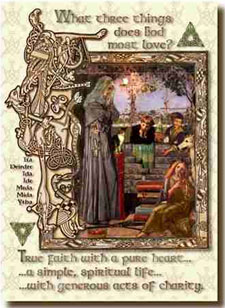
At a Young age Ita had a  hunger for the things of God. One night in a dream an angel appeared and presented  3  precious stones to her. When she inquired as to the meaning of the stones, the angel revealed that they symbolized the Trinity, Further  this would be a constant guiding presence in her life if she so desired.  Not only did she embrace the revelation, she prayed and fasted  seeking God's  direction more clearly,  learning to listen to and discern the leading of the spirit.

Ita began to experience change and transformation in herself and those around her.  Her father had refused his young daughters request to dedicate her life to the service of Christ and others. Her fathers mind was changed when he had a vision of how his daughters life would touch the lives of  the people.

Ita's  was  led to Kileedy  in County Limerick to establish a monastic community. She became known for her teaching and the power of prophecy and healing. Through out her life she cultivated  the practice of listening and responding to God.

Ita was convinced that the spirit was the true teacher and with that conviction established a school for boys, who came from far and near.. Many of her students went on to become well known followers of Christ in there own right. She has became affectionately referred to as the foster mother of the Irish Saints. One such foster son was Brendan the Navigator.

complied from several sources.

graphic: St. Ita, foster-mother to the saints of Ireland by Bridget Haggerty


Two Early Desert Fathers

http://frbasilhenry.files.wordpress.com/2012/01/desert.jpg


Paul the Hermit (233 -345 )

Seeking refuge in the desert during persecution, Paul of Thebes became the first known Christian hermit.  He lived in a cave until he died at the age of 112. Legend goes that St. Anthony  with Paul at the time of his death, having opportunity to break bread,  pray for  and bury the Saint in his clock.

Macarius the Egyptian (300 - 390 )

Macarius was also a desert hermit.  He played an important role in the early development of monasticism gathering fellow ascetic in supportive communities. His Christ like character and the pastoral care that he extended to his fellow hermits was renown 

Sunday, January 13, 2013

George Fox (1624 - 1691 )

 Walt whitman who was raised by parents inspired by Quaker thought, later wrote: "George Fox stands for something —a thought—the thought that wakes in silent hours—perhaps the deepest, most eternal thought latent in the human soul. This is the thought of God, merged in the thoughts of moral right and the immortality of identity. Great, great is this thought—aye, greater than all else."
                                                                                                                                                     
The son of a Leichestershire weaver, Fox lived in a time of great social upheaval and war. He rebelled against the religious and political authorities of the day by proposing an unusual and uncompromising approach to the Christian faith,. While working as a shoemakers apprentice, He felt called to travel in search of enlightenment 

After years of internal struggle he found peace when he surrendered to what  he described as the "inner light of the living Christ".  Preaching from this inner light He traveled throughout Britain as a dissenting preacher, for which he was often persecuted by the authorities who disapproved of his beliefs.

In prayer and meditation he came to a greater understanding of the nature of his faith and what it required from him; this process he called "opening". He also came to what he deemed a deep inner understanding of standard Christian beliefs.This lead to his  establishing the society of friends (the Quakers )

Among his ideas were:
  • Rituals can be safely ignored, as long as one experiences a true spiritual conversion.
  • The qualification for ministry is given by the Holy Spirit not by ecclesiastical study. This implies that anyone has the right to minister, assuming the Spirit guides them, including women and children.
  • God "dwelleth in the hearts of his obedient people": religious experience is not confined to a church building.  Fox refused to apply the word "church" to a building. Fox would just as soon worship in fields and orchards, believing that God's presence could be felt anywhere.
  • Though Fox used the Bible to support his views, Fox reasoned that, because God was within the faithful, believers could follow their own inner guide rather than rely on a strict reading of Scripture or the word of clerics.
  • Fox made no clear distinction between Father, Son and Holy Spirit.
 Fox married Margret Fell, the widow of one of his wealthier supporters; she was among one of many woman leaders among the Friends. His ministry expanded and he undertook tours of  North America, the West Indies and the Low countries. In the middle of those trips  he was imprisoned for over a year. He spent the final decade of his life working in London to organize the expanding Quaker movement.

Fox's charisma, selflessness, tireless commitment, deep spirituality and organizational abilities made him a remarkably charismatic personality. His greates legacy to the society of friends became the movements profound dedication to the work of peace, reconciliation and non-violence.

 compiled from several sources

Hilary of Poiters (315 - 367 )

A highly cultured and educated french man born  to wealthy polytheistic  nobility.  Hilary’s early life was uneventful  he married, had children , and studied  on his own. Through his studies he came to believe in the practice of  good works, then monotheism. As he studied the Bible for the first time, he literally read himself   to faith and states he was converted by the end of the New Testament 

At the age of 35, Hillary was elected as the new bishop of Poitier.   He opposed the emperor’s attempt to control the Church, and was exiled; spending four years in the east. 

He became an opponent of Arian theology which held that Jesus was less than divine to this end he devoted his creative talents as a writer and a teacher.  He developed the use of hymns to teach doctrine and is sometimes regarded as the first Latin hymn writer,. He is said to have been by nature mild and affable. He introduced Eastern theology to the Western Church.  

The later years of Hilary's life were spent in comparative quiet.  He worked on his expositions of the Psalms, an allegorical exegesis of the Gospel of Matthew and his now lost translation of Origen's commentary on the Book of Job.  Toward the end of his time as Bishop and with the encouragement of his disciple Martin, the future bishop of Tours, he founded a monastery at LigugĂ© in his diocese. Hillary died in 368 A.D.

 "Little children follow and obey their father. They love their mother. They know nothing of covetousness, ill-will, bad temper, arrogance and lying. This state of mind opens the road to heaven. To imitate our Lord’s own humility, we must return to the simplicity of God’s little ones." Hilary of Poiters

compiled from several sources


Saturday, January 12, 2013

Menno Simons (1496 - 1561 )

mennosimons17
“We do not teach and practice community of goods but we teach and testify the Word of the Lord, that all true believers in Christ are of one body (I Cor. 12:13), partakers of one bread (I Cor. 10:17), have one God and one Lord (Eph. 4).  Seeing then that they are one, . . . it is Christian and reasonable that they also have divine love among them and that one member cares for another, for both the Scriptures and nature teach this. They show mercy and love, as much as is in them.  They do not suffer a beggar among them. They have pity on the wants of the saints.  They receive the wretched.  They take strangers into their houses.  They comfort the sad.  They lend to the needy.  They clothe the naked. They share their bread with the hungry.  They do not turn their face from the poor nor do they regard their decrepit limbs and flesh (Isa. 58).  This is the kind of brotherhood we teach.”

 "The regenerated do not go to war, nor engage in strife.  They are children of peace who have beat their swords into plowshares and their spears into pruning forks, and know no war."

“True evangelical faith is of such a nature it cannot lie dormant, but spreads itself out in all kinds of righteousness and fruits of love; 
it dies to flesh and blood; 
it destroys all lusts and forbidden desires; 
it seeks, serves and fears God in its inmost soul; 
it clothes the naked; 
it feeds the hungry; 
it comforts the sorrowful; 
it shelters the destitute;
 it aids and consoles the sad;
 it does good to those who do it harm; 
it serves those that harm it; 
it prays for those who persecute it; 
it teaches, admonishes and judges us with the Word of the Lord; 
it seeks those who are lost;
 it binds up what is wounded; 
it heals the sick ; 
it saves what is strong (sound); 
it becomes all things to all people.
' 

' Christ is our fortress; patience our weapon of defense; the Word of God our sword.  ...Iron and metal spears and swords we leave to those who, alas, regard human blood and swine’s blood of well-nigh equal value."

In 1536 at the age of 40 Menno Simons a Roman Catholic priest in the Netherlands , ,left the priest hood .  soon after he became a leader within the Anabapist movement helping to organize scattered groups of nonviolent practitioners.  He would spend the rest of his life as a hunted man with a price on his head. 


Benedict Biscop ( 628 - 690 )

Benedict was born of nobility in  Northumbria  at the time  of King Oswiu At the age of 25 he made the first of five trips to Rome. When he returned to England, he was "full of fervor and enthusiasm, during his life time helped introduce religious practices learned in Rome bring the  indigenous Celtic church  in to sync with the Roman Church.

 On his  second journey to Rome he was accompanied by Alchfirth of Deira, a son of King Oswiu. On the return journey to England Benedict stopped at Lerin's, a monastic island off the Mediterranean coast of Provence. During his two-year stay he underwent a course of instruction, taking monastic vows.

Benedict's vision was to establish  a monastery for England modeled in the western European style. It was the first ecclesiastical building in Britain to be built in stone (up to that time the Celts had preferred wooden building or the out of doors for worship). He is also credited for bringing stain glass and Gregorian chant to England. The monastery  eventually encluded  a large library – several hundred volumes –  it was here that Benedict's student Bede wrote his famous works.

 For the last three years of his life Benedict was stricken with paralysis. He died on 12 January 690

Wednesday, January 9, 2013

Free Will (10)

Irenaeus on free Will
 
"Has the Word come for the ruin and for the resurrection of many? For the ruin, certainly, of those who do not believe Him, to whom also He has threatened a greater damnation in the judgment-day than that of Sodom and Gomorrah; but for the resurrection of believers, and those who do the will of His Father in heaven. If then the advent of the Son comes indeed alike to all, but is for the purpose of judging, and separating the believing from the unbelieving, since, as those who believe do His will agreeably to their own choice, and as, [also] agreeably to their own choice, the disobedient do not consent to His doctrine; it is manifest that His Father has made all in a like condition, each person having a choice of his own, and a free understanding; and that He has regard to all things, and exercises a providence over all, "making His sun to rise upon the evil and on the good, and sending rain upon the just and unjust."

"And to as many as continue in their love towards God, does He grant communion with Him. But communion with God is life and light, and the enjoyment of all the benefits which He has in store. But on as many as, according to their own choice, depart from God, He inflicts that separation from Himself which they have chosen of their own accord. But separation from God is death, and separation from light is darkness; and separation from God consists in the loss of all the benefits which He has in store. Those, therefore, who cast away by apostasy these forementioned things, being in fact destitute of all good, do experience every kind of punishment. God, however, does not punish them immediately of Himself, but that punishment falls upon them because they are destitute of all that is good. Now, good things are eternal and without end with God, and therefore the loss of these is also eternal and never-ending. It is in this matter just as occurs in the case of a flood of light: those who have blinded themselves, or have been blinded by others, are for ever deprived of the enjoyment of light. It is not, [however], that the light has inflicted upon them the penalty of blindness, but it is that the blindness itself has brought calamity upon them: and therefore the Lord declared, "He that believeth in Me is not condemned," that is, is not separated from God, for he is united to God through faith. On the other hand, He says, "He that believeth not is condemned already, because he has not believed in the name of the only-begotten Son of God;" that is, he separated himself from God of his own accord. "For this is the condemnation, that light is come into this world, and men have loved darkness rather than light. For every one who doeth evil hateth the light, and cometh not to the light, lest his deeds should be reproved. But he that doeth truth cometh to the light, that his deeds may be made manifest, that he has wrought them in God."  

(Irenaeus, Against Heresies, Bk. V, XXVII)

Sunday, January 6, 2013

Ancient Celtic Baptisim Blessing


THOU Being who inhabitest the heights
Imprint Thy blessing betimes,
Remember Thou the child of my body,
In Name of the Father of peace;
When the priest of the King
On him puts the water of meaning,
Grant him the blessing of the Three
     Who fill the heights.
   The blessing of the Three
     Who fill the heights.

Sprinkle down upon him Thy grace,
Give Thou to him virtue and growth,
Give Thou to him strength and guidance,
Give Thou to him flocks and possessions,
Sense and reason void of guile,
Angel wisdom in his day,
That he may stand without reproach
     In Thy presence.
   He may stand without reproach
     In Thy presence.

Carmicheal's foot notes: IT is known that a form of baptism prevailed among the Celts previous to the introduction of Christianity, as forms of baptism prevail among pagan people now. Whenever possible the Celtic Church christianized existing ceremonies and days of special observance, grafting the new on the old, as at a later day Augustine did in southern Britain. Immediately after its birth the nurse or other person present drops three drops of water on the forehead of the child. The first drop is in the name of the Father, representing wisdom; the second drop is in the name of the Son, representing peace; the third drop is in the name of the Spirit, representing purity. If the child be a male p. 115 the name 'Maol-domhnuich,' if a female the name 'Griadach,' is applied to it temporarily. 'Maol-domhnuich' means tonsured of the Lord, and 'Griadach' is rendered Gertrude. When the child is ecclesiastically baptized--generally at the end of eight days--the temporary is superseded by the permanent name. This lay baptism is recognised by the Presbyterian, the Anglican; the Latin, and the Greek Churches. If the child were not thus baptized it would need to be carefully guarded lest the fairies should spirit it away before the ecclesiastical baptism took place, when their power over it ceased. The lay baptism also ensured that in the event of death the child should be buried in consecrated ground.

Carmina Gadelica, Volume 1, by Alexander Carmicheal, [1900]

Epiphany (6)


The People that in Darkness Sat

A glorious light have seen;
The light has shined on them who long
In shades of death have been,
In shades of death have been.

To hail you, Sun of Righteous,
The gathering nations come;
They joy as when the reapers bear
Their harvest treasures home,
Their harvest treasures home.

To us the Child of hope is born,
To us the Son is given,
And on his shoulder ever rests
All power in earth and heaven,
All power in earth and heaven.

His name shall be the Prince of Peace,
The Everlasting Lord,
The Wonderful, the Counselor,
The God by all adored,
The God by all adored.

His righteous government and power
Shall over all extend;
On judgment and on justice based,
His reign shall have no end,
His reign shall have no end.

Lord Jesus, reign is us, we pray,
And make us yours alone,
Who with the Father ever are
And Holy spirit, one,
And Holy spirit, one.

Thursday, January 3, 2013

a Blessing of Solitude


May you recognize in your life, the presence, power and light of your soul.
May you realize that you are never alone,
That your soul in its brightness and belonging
connects you intimately with the rhythm of the universe.
May you have respect for your own individuality and difference.
May you realize that the shape of your soul is unique,
that you have a special destiny here,
That behind the facade of your life
there is something beautiful, good, and eternal happening.
May you learn to see yourself with the same delight, pride,
and expectation with which God sees you in every moment.

John O'Donohue (1956-2008)
(from Anam Cara)