Showing posts with label Irish. Show all posts
Sunday, November 3, 2013
Saturday, May 4, 2013
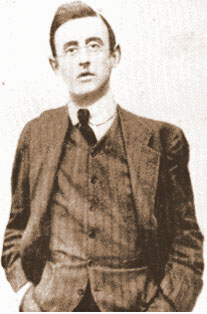
Joseph Mary Plunkett (1887 - 1916)
The Splender of God
The drunken stars stagger across the sky,
The moon wavers and sways like a wind-blown bud,
Beneath my feet the earth like drifting scud
Lapses and slides, wallows and shoots on high;
Immovable things start suddenly flying by,
The city shakes and quavers, a city of mud
And ooze—a brawling cataract is my blood
Of molten metal and fire—like God am I.
When God crushes his passion-fruit for our thirst
And the universe totters—I have burst the grape
Of the world, and let its powerful blood escape
Untasted—crying whether my vision durst
See God’s high glory in a girl’s soft shape—
God! Is my worship blessed or accurst?
Joseph Mary Plunkett .was born in Dublin and educated at Catholic University School, Belvedere College and Stonyhurst College. For a while he was editor of the Irish Review. He was a close friend of Thomas MacDonagh and Padraic Pearse,
noted Irish poets. Along with MacDonagh and Edward Martyn, he co-founded
the Irish Theatre.
During the 1916 Rising he was one of the signers of the Proclamation of the Irish Republic. He was imprisoned by the English army in the Richmond Barracks. Shortly before his execution in the courtyard of Kilmainham jail, on the morning of May 4th, he married his fiance, Grace Gifford, in the jail's chapel. He died at the age of 28. One of the best known romantic tragedies, his marriage to Grace has become both song and fable.
His friend, Thomas MacDonagh was executed the day before. The interrelationships between the poets of Dublin emerge many times. Francis Ledwidge, another of the poets of the day, wrote a Lament to thomas MacDonagh. Joseph's father and brother John, who were also involved in the 1916 uprising, served ten years penal servitude. Joseph's wife, Grace, was also later imprisoned in the Kilmainham jail.
Plunkett was deeply influenced
by his study of the mystics, including Saint John of the Cross, Saint
Theresa of Avila and Saint Francis de Sales. His poetry was published in two volumes: "The Circle
and the Sword", in 1911 and the “Occulta", published posthumously. His
sister, Geraldine Plunkett acted as editor and contributed a foreword. During the 1916 Rising he was one of the signers of the Proclamation of the Irish Republic. He was imprisoned by the English army in the Richmond Barracks. Shortly before his execution in the courtyard of Kilmainham jail, on the morning of May 4th, he married his fiance, Grace Gifford, in the jail's chapel. He died at the age of 28. One of the best known romantic tragedies, his marriage to Grace has become both song and fable.
His friend, Thomas MacDonagh was executed the day before. The interrelationships between the poets of Dublin emerge many times. Francis Ledwidge, another of the poets of the day, wrote a Lament to thomas MacDonagh. Joseph's father and brother John, who were also involved in the 1916 uprising, served ten years penal servitude. Joseph's wife, Grace, was also later imprisoned in the Kilmainham jail.
Sunday, March 17, 2013
Patrick of Ireland (389-460 AD)
Patrick left Confession and Letter to Coroticus in his own hand. These Two documents are the basis for all we know of the historical Patrick. Confession was aimed at an apparently unsympathetic audience in Britain to defend his call and mission to the people of Ireland.. It is not a traditional biography.
He was born Patricius somewhere in Roman Britain to a relatively wealthy family. He was not religious as a youth and, in fact, claims to have practically renounced the faith of his family. While in his teens, Patrick was kidnapped in a raid and transported to Ireland. He was enslaved to a local warlord and worked as a shepherd until he escaped six years later.
Patrick returned home and eventually undertook studies for the priesthood with the intention of returning to Ireland as a missionary to his former captors. It is not clear when he actually made it back to Ireland or how long he ministered there. We know it was definitely for a number of years.
Thomas Cahill author of How the Irish Saved Civilization says, "The Patrick who came back to Ireland with the gospel was a real tough guy. He couldn't have been anything else—only a very tough man could have hoped to survive those people. I don't mean to say he wasn't a saint—he was a great saint—but he was a very rough, vigorous man."
Not surprisingly Patrick's own experience in captivity left him with a distaste of slavery. He would later become one of the first voices to speak out unequivocally against it. "The papacy did not condemn slavery as immoral until the end of the 19th century," Cahill says, "but here is Patrick in the fifth century seeing it for what it is. I think that shows enormous insight and courage and a tremendous 'fellow feeling. The ability to suffer with other people. To understand what other people's suffering is like." Cahill adds "He really is one of the great saints of the downtrodden and excluded—people that no one else wants anything to do with,".
Women find a great advocate in Patrick. His Confession speaks of women as individuals. Cahill points to Patrick's account of "a blessed woman, Irish by birth, noble, extraordinarily beautiful—a true adult—whom I baptized." In another passages he speaks highly of the strength and courage of Irish women: "But it is the women kept in slavery who suffer the most—and who keep their spirits up despite the menacing and terrorizing they must endure. The Lord gives grace to his many handmaids; and though they are forbidden to do so, they follow him with backbone." He is actually one of the first male Christian's since Jesus to speak well of women observes Cahill.
Cahill points out around the time of Patrick's death "the Irish stopped slave trading and they never took it up again. Human sacrifice had become unthinkable. Although the Irish never stopped warring on one another, violence became much more confined and limited by what we might call the 'rules of warfare."
"I think that though he probably died knowing that he had succeeded [in his mission]," Cahill adds, "he also died hoping that success would be permanent and not temporary." The fact is Patrick's success couldn't have been more permanent. Not only had he accomplished what he'd set out to do—convert the nation to Christ—but in the process he'd retrieved from obscurity the primary objective set by Christ for his apostles: the spread of the gospel to the ends of the earth.
Cahill makes the strong case in How the Irish Saved Civilization, that it is Patrick's conversion of Ireland that sets in motion the preservation of Western thought through the early Dark Ages by the Irish monasteries founded by Patrick's successors. When the lights went out all over Europe, a candle still burned in Ireland. That candle was lit by Patrick.
By converting the Irish pagans to Christianity without making any attempt to Romanize them he founded a new kind of Church. One that was both Catholic and primitive. Of Patrick's introduction of Christianity to Ireland, Cahill says, the faith was introduced for the first time into a culture free of the sociopolitical baggage of Greco-Roman civilization. Prior to Patrick's gift of the faith to Ireland, to be Christian was to be Roman, or at least to be a product of Roman civilization.
The conversion of Ireland sees the faith thrive in an entirely different environment. A culture in which, according to Cahill, there is a "sense of the world as holy, as the Book of God—as a healing mystery, fraught with divine messages." In this tradition, Cahill explains, "there is a trust in the objects of sensory perception, which are seen as signposts from God. But there is also a sensuous reveling in the splendors of the created world, which would have made Roman Christians exceedingly uncomfortable."As a result, Cahill says, "The early Irish Christianity planted in Ireland by Patrick is much more joyful and celebratory in the way it approaches the natural world. It is really not a theology of sin but of the goodness of creation, and intensely incarnational."
Since it was the Irish monks who served as the bridge between classical Christianity and the Middle Ages, medieval Christianity tends to reflect the celebratory nature of Irish spirituality rather than the gloom and sin-centeredness of its classical predecessor.Finally. Patrick gave the Irish himself, willingly, joyfully, proudly. He did this despite the fact that, even at the end of his life, "after aproximatly30 years of missionary activity," Cahill says, "he knows he's still living in a very scary place. You don't change people who offer human sacrifice and who war on one another constantly, overnight."
But change they eventually did. The example of his life—his courage, his intelligence, his compassion and his incredible, indomitable faith still lives on.
Cahill writes, "Only this former slave had the right instincts to impart to the Irish a New Story, one that made sense of all their old stories and brought them a peace they had never known before." Because of Patrick, a warrior people "lay down the swords of battle, flung away the knives of sacrifice, and cast away the chains of slavery."
compiled from several sources
Thursday, March 14, 2013
Anam Cara (part 2)
The Celtic Connection
For
more than six hundred years from 400 to 1200 C.E., monastic biographers
in the Celtic churches of Ireland, Northern England, Cornwall,
Scotland, Wales, the Isle of Man, and Brittany composed the Lives of
literally hundreds of Celtic saints. These records leave a wealth of
information about soul friendship and its immersion in the everyday life
and spirituality of Celtic Christianity. Also revealed is how common
soul-friend relationships were between men and men, women and women, and
women and men and the importance of everyone having a soul friend even
among non clerics.
Records
tell us within a hundred years after the missionary activities of Saint
Patrick in the fifth century, saint after saint were involved in soul
friend relationships.
Ita
as Finan evidently acted in a similar capacity. She taught so many
young men who later became leaders in the early Celtic church that she
became known as the "Fostermother of the Saints of Erin." One of these
is Brendan of Clonfert. Famous for his voyages, he frequently turned to
Ita for advice throughout his life.
A
person may have a number of mentors and soul friends through out their
lifetime. Often starting from an early age. Kevin of Glendalough is
typical of this model. According to an early hagiography, he had "three
elders to whom he was handed over as a child, so that he might learn
Christ."
As
Anam Caram, these early saints engaged in a great variety of ministries
and roles. Some, like Patrick, Brigit, and Columcille, are clearly
portrayed in their Lives as healers and spiritual guides to the tribes,
as the druids and druidesses had once been before them.
Others
such as Finnian, Ita, and Aidan, functioned as teachers and tutors both
to younger and older students alike. Many of them, including Findbarr
of Cork, David of Wales, and Hild of Whitby, were powerful founders of
monasteries, a role that definatley involved good communication and
administrative skills.
As
in the case of Brendan and Columbanus, a large number were missionaries
and pilgrims. They willing to lived extremely harsh lifestyles, far
from friends and kin, to bringing the gospel to pagan lands.
Many
of these soul friends were mystics and visionaries, like Samthann of
Clonbroney and Maedoc of Ferns, who prayed intensely and had seer,
intuitive abilities to read the future and, more important, the heart.
All of them were pioneers, reconcilers, and confessors who, despite a
very active life, valued deep freindships and solitude.
We
know from the few hagiographies of female "saints" as well as the
stories in the men's Lives that refer to women in the early Celtic
church, that some of the greatest and most competent of the soul friends
were Irish women. Brigit, Ita, Samthann, Moninna, and in Northumbria.
The anglo-saxon Hild of Whitby, who, through Aidan's mentoring, was
thoroughly immersed in Celtic spirituality. These woman funtioned as
teachers, administrators, guides, preachers, and confessors in the
Celtic tradition.
Older
members, ascetics, and anchorites would probably have had their own
separate cells. Many of these cells were of the beehive type still
visible today in all their terrible beauty on Skellig Michael, off the
Ring of Kerry in Ireland. This type of cell definitely had room for more
than one inhabitant.
In
his Ecclesiastical History of the English People, the Venerable Bede
tells us that during the early days of the Celtic church large numbers
of people from England "left their own country and retired to Ireland
either for the sake of religious studies or to live a more ascetic life.
In course of time some of these devoted themselves faithfully to the
monastic life. Others preferred to travel round to the cells of various
teachers and apply themselves to study." Cells were frequently shared
between teachers and students, confessors and those seeking forgiveness,
and anam caram.
adapted from material by Edward Sneller
Friday, December 7, 2012
Monasticism (14)
Irish Monasticism (part 2)
In Ireland the church was always the local church. There was nothing
else. The local tribe was the point of meeting one with the other, and
the number of tribes was enormous, though they might be joined up in
little kingdoms or bigger ones. When the tribe responded to the Gospel,
an enclosure would be set aside, with boundaries and ‘termon’ crosses,
sometimes with a ditch, sometimes with a wall, clearly marking out to
everyone that the area was sacred. Within it a tiny church of wattle and
daub would be built. That would not take long.
In many places there seems to have been no shortage of aspiring
monks. As for sites, as one travels to the places they chose one is
amazed by the astonishingly beauty of the places they picked. In
particular the sea islands (particularly off the West coast) and the
many Lough Islands furnished such places in abundance. Even today
travelling throughout the island the memory of the founding saints is
singularly well preserved, though often there is little detail.
Something is known of some 250 from this early period but this does not
include many more, without number, whose names are hardly known, were
never recorded, or which have become lost.
Whoever they were, bishops, monk or hermits (and some bishops were
monks or even hermits) some founded several churches. 4000 is the
estimated overall number. Of course nothing survives of the perishable
materials used. But where wood was plentiful, churches were also made of
planks; or if there was little wood, in stone. Apart from Duleek (7C),
the first stone churches however appear to be the tomb-shrines of
founder saints in the 8C, but then in increasing numbers from the 8th
-10th centuries. As stone churches these can be recognised by the
‘antae’, that is, flat projecting gable-ends, which imitate upright
corner timbers on their wooden predecessors. They had doors in the west
(gable) end and sometimes a wonderful doorway made of very large
well-dressed stones. As the churches were often small, the people stood
outside - outdoor altars being in some cases provided where they could
say their prayers. There were perhaps a few larger churches, first in
wood, and later in stone.
Many monasteries were built at tribal centres or at meeting places on
tribal boundaries. As some monastic communities grew they attracted a
resident local community in an arrangement that was of benefit to all.
The monasteries provided their spiritual ministrations to local families
and taught the children; families helped with the agricultural labour,
and with livestock. The dynamic went well – monastery and village grew
together. This enabled the monks to take on such great tasks as creating
and copying of literature and highly specialised metal-ware. But there
were drawbacks. The principal one was that the tribal leader asserted
his right to appoint the abbot, who might well turn out to be one of his
own family. Worse still, when tribes were involved in a fight, the
monks were expected to join in. Then there were the ‘manaim’.
In spite of the fact that the origin of this term and that of the
word ‘monk’ is the same these were not the married monks, but men with
families who lived round the monastery and who, with their families,
lived under considerable religious discipline alongside their spiritual
if not natural brothers in the monastery. This included no small degree
of sexual abstinence. Any suggestion that these were monks indulging in
gross laxity or immorality has to be discounted. Such a life sounds like
another of those Irish solutions which had its rationale ‘on the
ground’. It is all about finding ‘in-between meanings’. The Irish have
always helped us think outside of our boxes – that is very much part of
being Irish. Tertiaries in Western monasteries is another ‘in-between
arrangement’. In the East married men have always been encouraged to
spend time in a monastery.
thanx: to early christian Sites in Ireland
Saturday, November 24, 2012
Monasticism (13)
Irish Monasticism part 1
The ‘Catalogue of the Saints of Ireland’ divided the Saints of Ireland into three orders. The first contains all those bishops deemed to have received their ministry from St Patrick. The second lists monks who had received their ministry from Britain. The third consists of hermits. But the document is of 9C or even 10C and is clearly designed to boost the prestige of Patrick and his bishops over against the monks and hermits. But these orders were not consecutive but contemporary one with another and should be dated to the 6C. This century was one of great expansion which saw not only bishops, but monks and hermits, spreading everywhere in Ireland. The result was that the monasteries became the de facto centres of the church. Monasticism, with its multiple forms, had great appeal because its adaptability.
The traditional founder of the monastic movement is said to have been St Finnian
of Clonard (548) who had received training in Wales. He was undoubtedly
a great founder and teacher. But there were many before him.
Patrick’s relation to the monastic life is unclear though interesting.
Some deny he founded any monasteries on the grounds that bishops came
first and monks later. Yet St Patrick was firmly in favour of the
dedicated life; he refers to it four times. Most explicit is his
statement that, ‘The sons of the Irish and the daughters of their kings
are monks and brides of Christ’. But even if this only referred to
individuals not communities – and this is not clear- for a bishop in the
5th C to be so positive is unusual. His companion St Tassach
(470), founder of the church at Raholp just 2 miles from Saul, is said
to have spent 7 years on Rathlin O’Birne off the coast of Donegal with
other hermits before 500. If so this is of extraordinary interest. St Enda
(530) spent many years first as a hermit, founder of a monastery and
teacher of many on Inishmore, the main island of Aran Co Galway. St Donard (507) at Maghera Co Down is said to have had a hermit’s cell on top of Slieve Donard in the Mountains of Mourne. St Forthchern (5C), who is said to have been a bishop and then a hermit in Meath, may have been the teacher of Finnian. St Buite
(523) founded Monasterboice in Co Louth. St Senan (546) evangelised
West and South Clare and he and his disciples founded many places around
the Clare coast and on the islands of the Shannon estuary. There are
also several remarkable women saints from the early period, St Gobnait (5C) at Ballyvourney (Co Cork), St Arraght (5C) at Killaracht and Monasteraden (both Co Sligo), St Monnina at Killevy (Co Armagh) (517), St Brigit (524) at Kildare, St Bronagh at Kilbroney, Rostrevor (Co Down) and St Ita (570) at Killeedy (Co Limerick).
St Columba (597) was perhaps the most prolific founder of monasteries of all. Born at Garten in Co Donegal, he was of royal blood, of commanding stature and evidently of great charisma. He eventually left Ireland for Scotland where, from this base on Iona, he evangelised among the Picts. His ‘Life’ written by St Adamnan gives a vivid picture of an Irish saint and Irish monasticism..
The ‘Catalogue of the Saints of Ireland’ divided the Saints of Ireland into three orders. The first contains all those bishops deemed to have received their ministry from St Patrick. The second lists monks who had received their ministry from Britain. The third consists of hermits. But the document is of 9C or even 10C and is clearly designed to boost the prestige of Patrick and his bishops over against the monks and hermits. But these orders were not consecutive but contemporary one with another and should be dated to the 6C. This century was one of great expansion which saw not only bishops, but monks and hermits, spreading everywhere in Ireland. The result was that the monasteries became the de facto centres of the church. Monasticism, with its multiple forms, had great appeal because its adaptability.
The traditional founder of the monastic movement is said to have been St Finnian
of Clonard (548) who had received training in Wales. He was undoubtedly
a great founder and teacher. But there were many before him.
Patrick’s relation to the monastic life is unclear though interesting.
Some deny he founded any monasteries on the grounds that bishops came
first and monks later. Yet St Patrick was firmly in favour of the
dedicated life; he refers to it four times. Most explicit is his
statement that, ‘The sons of the Irish and the daughters of their kings
are monks and brides of Christ’. But even if this only referred to
individuals not communities – and this is not clear- for a bishop in the
5th C to be so positive is unusual. His companion St Tassach
(470), founder of the church at Raholp just 2 miles from Saul, is said
to have spent 7 years on Rathlin O’Birne off the coast of Donegal with
other hermits before 500. If so this is of extraordinary interest. St Enda
(530) spent many years first as a hermit, founder of a monastery and
teacher of many on Inishmore, the main island of Aran Co Galway. St Donard (507) at Maghera Co Down is said to have had a hermit’s cell on top of Slieve Donard in the Mountains of Mourne. St Forthchern (5C), who is said to have been a bishop and then a hermit in Meath, may have been the teacher of Finnian. St Buite
(523) founded Monasterboice in Co Louth. St Senan (546) evangelised
West and South Clare and he and his disciples founded many places around
the Clare coast and on the islands of the Shannon estuary. There are
also several remarkable women saints from the early period, St Gobnait (5C) at Ballyvourney (Co Cork), St Arraght (5C) at Killaracht and Monasteraden (both Co Sligo), St Monnina at Killevy (Co Armagh) (517), St Brigit (524) at Kildare, St Bronagh at Kilbroney, Rostrevor (Co Down) and St Ita (570) at Killeedy (Co Limerick).St Columba (597) was perhaps the most prolific founder of monasteries of all. Born at Garten in Co Donegal, he was of royal blood, of commanding stature and evidently of great charisma. He eventually left Ireland for Scotland where, from this base on Iona, he evangelised among the Picts. His ‘Life’ written by St Adamnan gives a vivid picture of an Irish saint and Irish monasticism..
Friday, June 22, 2012
the Lords Prayer in Irish Gaelic
The Lord's Prayer in Irish Gaelic
Ár n-Athair
|
| Ár n-Athair atá ar neamh, Go naofar d'ainim, Go dtagfadh do ríocht, Go ndéantar do thoil ar an talamh mar a dhéantar ar neamh. Ár n-arán laethúil tabhair dúinn inniu, agus maith dúinn ár bhfiacha mar a mhaithimidne dár bhféichiúna féin (Ach ná lig sinn i gcathú, ach saor sinn ó olc,) graphic: Irish Countryside south of Dublin |
Monday, June 11, 2012
Monasticism (7) IONA: A Brief History
Iona. The
monastery founded by St Columba in 563 soon became the center for Celtic
Christianity, sending out missionaries to Scotland and Northumbria.
Although the ravages of Viking raids before and after 800 made Iona a
more dangerous place to live, its prestige continued well into the 9th
cent. Following a massacre of its monks in 806, work began apace on the
Irish midland monastery of Kells, which was gradually to become the
focus of the Columban communities in Ireland. Kells was finished in 814,
and not long after (c.818), a new Columban monastery in central
Scotland was founded, Dunkeld. It is generally held that in 849 the
relics of St Columba were split between the two new monasteries,
confirming shifts in patronage and power centers which had been under
way for some time. From the end of the 9th cent., we find the head of
the Columban communities, the comarba Choluim Chille, based in Kells,
and the headship remained there until the 12th cent.
None the less,
Iona's importance as a religious centre continued, and began to attract
the newly converted Norse settlers of the Hebrides. Two Norse cross
slabs are now housed in the Iona museum, one bearing an inscription in
Norse runes, another bearing a scene from Norse legend. In 980, the
powerful king of Viking Dublin, Olaf Cuarán, died on pilgrimage to the
island. This was an up-and-down relationship, however, as six years
later, a raiding party from the Northern Isles slaughtered the elders of
the monastery and the abbot.
The wider
influence of Iona monks can be seen as far afield as Carolingian Europe.
Dicuil, a cosmographer who wrote a description of the world c.825 in
the court of Charles the Bald, probably came from Iona, and he describes
other Iona monks ranging as far north as the Faroes and as far south as
Egypt. The martyrdom of Blathmac, son of Flann, defending the relics of
Columba from Viking raiders in 825 caught the imagination of Walahfrid
Strabo, based in the monastery of Reichenau on Lake Constance. One of
the 10th-cent. heads of the Columban communities, Mugrón (965–81), who
appears to have been partially based in Scotland, was a devotional
writer of some skill.
The 11th cent.
was marred by such incidents as the loss of some of Columba's relics on a
journey back to Ireland from Iona (in 1034), and slaying of the abbot
by a rival, the son of a former abbot of Kells in 1070. None the less,
Scottish kings, according to tradition, continued to be buried there,
and Margaret, wife of Malcolm III, king of the Scots, held the monastery
in favour.
In the next
century, it again became the religious hub of a new island-centred
power-base. Somerled mac Gille-Brigde, the powerful Argyll sea-lord
whose descendants became the Lords of the Isles, attempted in 1164 to
lure the head of the Columban communities back to Iona. He failed, but
the building of a new Benedictine monastery in 1204, followed by an
Augustinian nunnery, spelled the return of Iona's fortunes. Closely
linked to the Lords of the Isles from the 14th cent. onwards, and the
seat intermittently of the bishop of the Isles, Iona in the later Middle
Ages was a great centre of sculpture. The present church on the island
dates substantially to the 15th-cent. renewal programme, and displays
the skills and patronage then available. Only with the forfeiture of the
lordship in 1493 and the Reformation did Iona's decline set in in
earnest.
- article by Thomas Owen Clancy
graphic: Iona Island, Iona Abbey, Iona coast line from the Abbey
Iona: A History By The Duke of Argyle 1871
Link to the Living water Article Hilda of Whitby and development of. Monasticism
This is one of the most popular posts on the site. Please feel free to leave comments. Also if you found this helpful or encouraging would appreciate if you'd consider following and informing others about this blog. Deep peace ... Brad
Saturday, May 5, 2012
Monasticism (part 4)

Celtic Monasticism
Influenced much by middle-eastern and Coptic monasticism.
Ninian (360-432) is the first recorded figure on the monastic scene in Brittan. On a return trip from Rome he meet Martin of Tours (316-97). Martin had founded a Monastery at Liguge in Gaul before becoming Bishop of Tours. He is credited with bringing monasticism West. Aside from possible direct contact with eastern monks we can trace the arrival of monasticism in Ireland and Whales from Martin in France through Ninan in Scotland. According to one story Patrick spent time at Ninan’s monastery studying monastic life.
Monk and monastery conjure up strange and stereotypical images for many of us. There were no large medieval stone monasteries or cloisters that formed a Celtic monastery. No large church buildings were erected the. Eucharist and communal acts of worship probably took place out doors as had formally been done. The natural connection between God and creation was maintained
Unlike the urban centers on the continent this was a tribal system with varying degrees of association or membership in the monastic family including lay members, married people, and singles, They were more like a ‘monastic village” than a huge complex building. The village was generally in a walled compound to keep animals in and raiders out. In Ireland these “villages” were the closest things to towns and became centers of hospitality, learning, agriculture, recreation, medicine, trade, commerce.
These monasteries were not often what we usually imagine. While some monasteries were in isolated places, many more were at the crossroads of provincial territories. Monasteries were often huge theocratic villages associated with a clan with the same kinship ties, along with slaves, freemen, celibate monks, and married clergy, professed lay people, children. Men, women and even a bishop or two living side by side as part of the community
All were encouraged to live the life of a monk even if married with children. The abbot or abbess was the administrator of the community leaving the sacramental and evangelical functions to the bishop or the priest. Bishops were part of the tribe consecrated as holy men rather than authority figures. There were often more than one or two in a monastery.
The Druids had sacred oaks, wells, and groves. These were considered thin places, where the veil between the natural world and the spiritual realm was tangible. Often these became the sights of monastic communities. Bangor is an example of a druid collage that became a monastery attracting thousands of students. Iona had been a pagan religious center known as the isles of the druids. It became a primarily force for Celtic monasticism. St Bridget’s center at Kildare” the Church of the Oak was established at a former Druid place of worship
These communities were theologically orthodox, yet heavy emphasis on the Trinity, a love and respect for Mary, the Incarnation of Christ, theosis, Imgieo dei, Creation as a theophany and a distinct Liturgy
graphic: Skeleg Micheal
Subscribe to:
Posts (Atom)